
LLM Enhancements
AKV Makes KV-Cache Retention a Serving Decision for LLM Agents
AKV reports lower agent inference costs through selective KV-cache reuse. Here is what the results mean for self-hosted serving stacks.
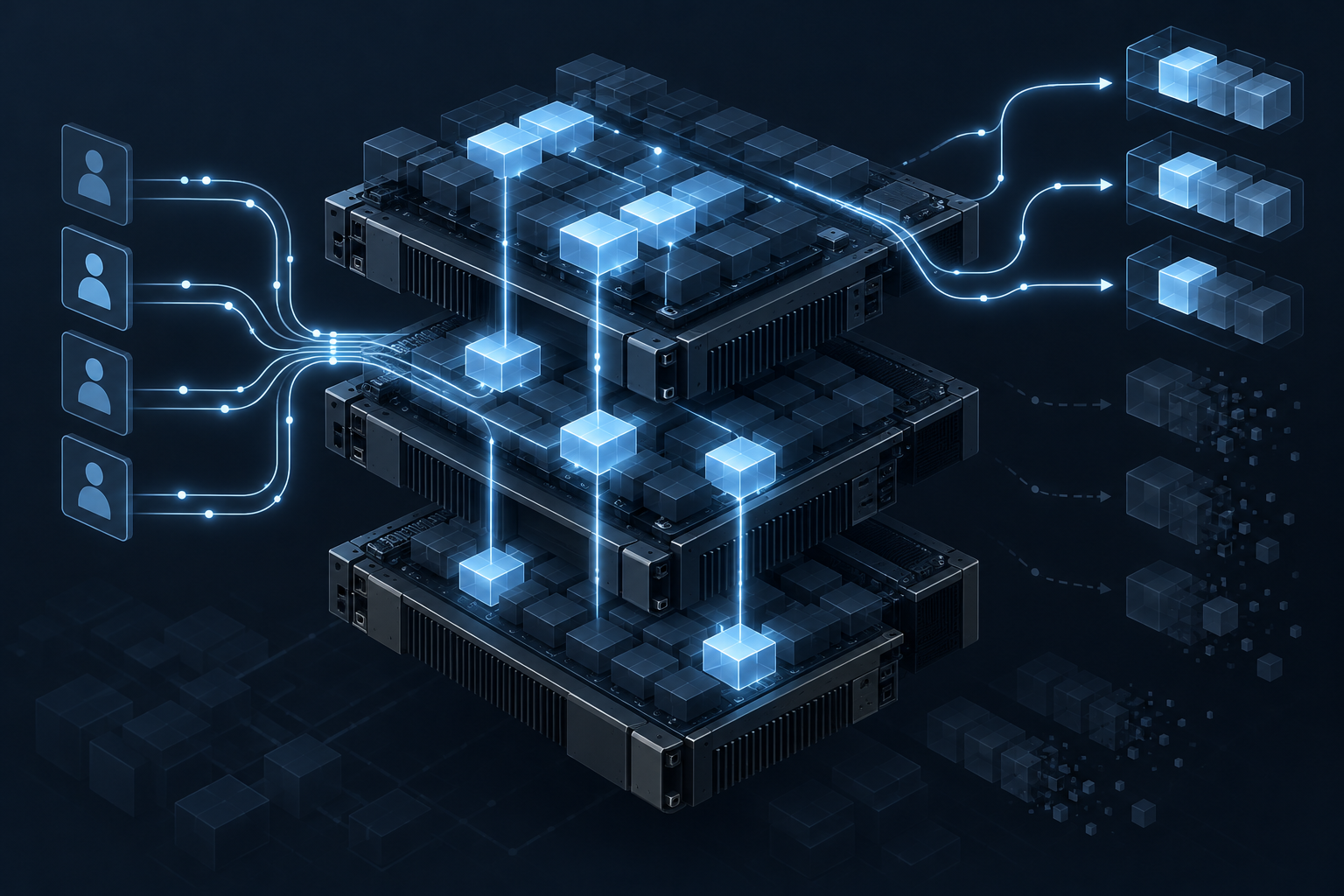
Agent inference makes conversation history an infrastructure problem. A task can involve planning, tool calls, observations, revised plans, and further model invocations. Each step adds context, but not every earlier token remains equally useful. Reprocessing that growing history can turn input computation into a recurring expense.
AKV, an open-source KV-cache serving system from researchers at Tsinghua University and The Chinese University of Hong Kong, targets this problem directly. Reported on October 26, 2026, it selectively removes internal KV-cache entries while preserving others for reuse across agent interactions. Its focus is not simply matching a shared prompt prefix. It is deciding which previously computed context state should remain available as an agent's trajectory evolves.[6]
The reported results are notable: 27.7% lower average cost across three models and four agent benchmarks, with separate peak-setting throughput improvements of 1.53× for input and 1.18× for output. Those figures justify attention, but they also require careful interpretation. For infrastructure teams, the important question is where selective cache retention changes serving economics, and what remains unproven.[6]
1. Why agent workloads need more than prefix caching
Conventional prefix caching works best when requests share an identical initial sequence. Previously computed state for that prefix can be reused instead of recomputed. Agent interactions create a less regular pattern: new tool results arrive, plans change, and later reasoning may revisit only selected parts of an earlier trajectory.[6]
Consider the structure of a tool-using workflow. An early observation may remain relevant several steps later, while an intermediate plan may have been superseded. Treating all prior interaction history as equally valuable does not reflect that difference. Yet retaining everything and repeatedly processing everything both carry infrastructure consequences as the trajectory grows.
Summarizing the history offers another approach. A shorter textual representation reduces the amount of input presented to later model calls, but it introduces a model-generated account of the past. That account can lose exact details that become important later. Summary generation also differs fundamentally from retaining the internal state already computed for selected tokens.[6]
AKV's central design is to drop selected KV-cache entries and keep reusing the rest. The retained information is model state, not a rewritten transcript. This makes the system a runtime memory-management technique rather than a conventional text-compression method.[6]
That distinction changes the optimization target. Instead of asking only whether two requests have the same beginning, the serving system asks which parts of an agent's existing context state should survive into later interactions. Prefix reuse and selective retention therefore address different aspects of repeated context processing. AKV's significance is that it treats retention as an explicit serving decision for agent workloads, rather than assuming the entire accumulated history deserves the same treatment.[6]
2. What AKV changes inside the serving stack
KV-cache entries contain intermediate attention information for tokens the model has already processed. Reusing that state can avoid repeating the corresponding computation. Removing entries, however, can change what the model attends to during future generation. Selective retention therefore connects cache policy directly to model behavior.[6]
The available reporting describes AKV as dropping selected entries and repositioning or reusing KV-cache blocks. It does not describe the approach as generating a textual summary of prior interactions. The distinction matters operationally: an engineer evaluating AKV is assessing a change to how the runtime maintains context state, not merely a preprocessing step that shortens a prompt.[6][7]
AKV runs on NVIDIA GPUs through SGLang. Its reported evaluation used eight NVIDIA A800-80GB GPUs with BF16 precision. That places the results in a concrete GPU serving environment rather than a standalone theoretical analysis.[6]
The report also describes a quick-start configuration that serves GPT-OSS-120B on two GPUs with tensor parallelism of degree two. This is useful deployment information, but it should remain separate from the eight-GPU evaluation configuration. A quick-start example is not, by itself, evidence that the published cost and throughput results were obtained under that same setup.[6]
For engineers, the implementation establishes a practical starting point for investigation: cache-management policy is integrated with an existing serving runtime. It does not establish that the policy will transfer unchanged to every model, accelerator, precision format, or agent framework. The available evidence supports conclusions about the reported implementation and environment, while broader compatibility and performance remain questions for independent evaluation.[6]
3. Reading the cost and throughput results correctly
The headline economic result is a reported 27.7% reduction in average cost across three models and four agent benchmarks. It is an average over the stated evaluation set, not a result attributed to only one model or benchmark. However, the available material does not provide the exact cost baseline or the distribution of savings across those workloads.[6]
That distinction prevents a direct conversion into a production savings forecast. A team cannot assume that its own mix of agent tasks, context lengths, and interaction patterns matches the evaluation set. Nor can it determine from the headline alone whether the gains were consistent across workloads or concentrated in a subset.
The throughput measurements require a separate qualification:
| Reported metric | Result | Scope qualification |
|---|---|---|
| Average cost | 27.7% lower | Across three models and four agent benchmarks |
| Input throughput | 1.53× | At each method's peak setting |
| Output throughput | 1.18× | At each method's peak setting |
All three figures come from the AKV report, but the throughput values specifically compare each method at its peak operating point. They do not demonstrate the same improvements at every concurrency level or under a shared latency constraint.[6]
Input processing corresponds primarily to prompt ingestion and prefill, while output processing corresponds to autoregressive decoding. The larger input-throughput improvement is consistent with AKV's focus on avoiding or reusing repeated context computation. It should not be read as a complete accounting of where every performance gain originates.[6]
The report supports the conclusion that both input and output throughput improved in the stated comparisons. It does not provide latency percentiles, cache hit rates, or complete baseline hardware configurations for every comparison. Those omissions matter to buyers: maximum throughput is useful, but it is not enough to establish capacity at a production service-level target.[6]
4. Selective retention creates a quality question as well as a performance question
Cache retention is not only a question of memory occupancy. Because KV state influences future attention, deleting entries can affect subsequent model behavior. A retention policy must therefore be evaluated against the agent's ability to complete its task, not just against the serving system's ability to process more tokens.[6]
The agent setting makes this especially important. An observation that appears unimportant during one step may become relevant after a later tool call. A revised plan may still depend on an exact detail from an earlier result. Selective retention aims to preserve useful state, but the available report does not establish that every deletion is behaviorally neutral.[6]
This does not make summarization automatically safer. Summarization can also lose details, and it substitutes a generated representation for the original history. The useful comparison is therefore not between an imperfect selective cache and a supposedly lossless summary. Teams should compare the actual alternatives they could deploy, including their effects on task completion and serving cost.
A production evaluation should pair performance measurements with workload-specific checks. For example, teams can test whether an agent still uses an earlier tool result correctly after intervening interactions, whether revised plans preserve necessary constraints, and whether longer trajectories finish successfully. These are recommended validation questions, not additional AKV results.
The economic comparison should likewise focus on completed work. A faster individual invocation is less valuable if later steps require retries or corrective calls. Conversely, preserving useful state across repeated invocations can matter beyond the latency of any one call. The reported average cost reduction makes this workflow-level evaluation worthwhile, but the missing per-workload detail means teams must establish the relationship between retention, quality, and cost for their own traffic.[6]
5. Where AKV fits among other inference optimizations
AKV targets the amount and organization of previously computed context state. That is a different optimization dimension from model-weight quantization, which can reduce memory pressure from parameters. Selective KV management addresses runtime state associated with long or repeated inputs. The reported AKV evaluation used BF16 and does not claim to replace quantization.[6]
It also differs from speculative decoding. Speculative decoding uses a smaller draft model to propose tokens that a target model verifies, reducing expensive target-model decoding iterations.[3] AKV instead manages context state that can be reused across agent interactions.[6]
A separate engineering note illustrates why these distinctions matter. In its tested code-generation configuration, drafting two tokens delivered a 1.47× speedup over plain decoding while using 6% more energy per token. That result is not an AKV comparison. It demonstrates that a speedup from another technique can have a different resource trade-off.[3]
The broader serving stack also includes continuous batching, paged memory management, attention kernels, and prefill/decode scheduling. A serving-harness discussion emphasizes that these parameters are coupled: changing precision, speculative-decoding depth, batching policy, or scheduling can shift the effective bottleneck.[10]
Infrastructure teams should therefore avoid treating published speedups as independent multipliers. AKV's reported input-throughput gain cannot simply be multiplied by a speculative-decoding result from a different workload to predict combined performance. The available evidence does not establish that combination.
The appropriate question is what limits the actual deployment. If repeated context processing is a substantial part of the workload, selective KV reuse is directly relevant. If another serving phase dominates, its effect may differ. AKV adds a cache-retention policy to the optimization space, but the surrounding runtime configuration still determines how that policy translates into useful capacity.[6][10]
6. What an independent evaluation needs to establish
The open-source release provides a path for independent deployment and testing. Reproducing a useful result, however, requires more than running the quick-start configuration. Teams need to distinguish the published environment from their own and document the comparison they intend to make.[6]
A practical evaluation should cover four areas:
- Baseline definition: Record the model, hardware, precision, serving runtime, and existing history-management behavior. Make clear whether the comparison uses full-history processing, summarization, or another cache policy.
- Workload representation: Include agent trajectories that reflect production tool use, repeated references to earlier observations, and evolving plans. A convenient prompt set is not necessarily representative of an agent workload.
- Operating-point comparison: Measure throughput alongside latency at the concurrency levels the service must support. Separately identify peak-throughput settings so that maximum capacity is not confused with performance under a fixed service target.
- Quality and economics: Track successful task completion and the cost of the complete workflow, including retries or extra model calls where they occur.
These are evaluation recommendations rather than measurements supplied by the AKV report. They address gaps that prevent the published averages from serving as a complete procurement or deployment case.
The available material does not name all three models or all four benchmarks, disclose the exact baseline for the 27.7% cost reduction, or provide the distribution of gains. It also does not establish equivalent results on other hardware generations, architectures, precision formats, or agent frameworks.[6]
Teams should use the reported NVIDIA A800-80GB, BF16, and SGLang environment as a reference, not a guarantee. An evaluation becomes decision-ready when it explains both the improvement and the conditions under which that improvement holds. For selective KV retention, those conditions include the workload's reuse pattern and whether the retained state remains sufficient for successful agent behavior.
7. What this means for teams running their own inference infrastructure
AKV makes a concrete case for treating context retention as part of serving design. Its reported 27.7% average cost reduction, 1.53× input throughput, and 1.18× output throughput show why agent infrastructure deserves attention beyond token-by-token decoding optimization. The results remain bounded by the stated evaluation set and peak-setting throughput comparisons.[6]
For self-hosted teams, the immediate implication is to examine how much work comes from repeatedly processing evolving agent history. Where that work is significant, selective KV management is a relevant candidate for testing. The open-source SGLang implementation offers a practical route to that investigation.[6]
For infrastructure buyers, the implication is to ask for more precise evidence. A useful vendor or internal benchmark should identify its cost baseline, hardware and precision, latency constraints, workload distribution, and task-quality outcomes. Headline throughput alone cannot answer whether the system lowers the cost of successfully completed agent tasks.
AKV should not be interpreted as a universal replacement for prefix caching, quantization, batching, or speculative decoding. It addresses a distinct question: which previously computed context state is worth carrying forward?[6] That question becomes increasingly important within any workflow that repeatedly revisits a growing history.
The engineering takeaway is straightforward: evaluate retention policy with the same care applied to other serving decisions. Measure its effect on performance, resource use, and agent behavior together. AKV supplies a concrete implementation and promising reported results. Teams running their own infrastructure must determine whether those results translate into reliable capacity and lower workflow cost under their operating conditions.
Sources
- [1]Green Code or Costly Code? Evaluating the Energy Costs of Iterative LLM-Based Code Optimizations
- [2]MemoraX AI Researchers and Collaborators Have 10 Papers
- [3]phase/notes/2026-10-speculative-decoding.md at main ... - GitHub
- [4][PDF] ReMedI: Inference-Time Refinement and Self-Distillation for Controllable Molecular Optimization | Semantic Scholar
- [5]LLMs in Cloud: A Discussion on Architecture, Orchestration, and Inference
- [6]Tsinghua AI Open-Sources AKV, a Cache Engineering ...
- [7]Tsinghua's AKV cuts LLM agent inference costs 27.7% - gekro
- [8]PD-Swap: Prefill-Decode Logic Swapping for End-to-End LLM ...
- [9]This week's papers in AI and software, in their authors' words
- [10]Designing an AI serving harness built to last - Extrapolator AI
Researched from the sources above and fact-checked against them before publishing.
See what this means for your infrastructure.
Book a discovery call and get a benchmark projection for your hardware and model.
SCHEDULE A CALL