
LLM Enhancements
DLite Reframes Speculative Decoding as a State-Management Problem
DLite reuses target-model hidden states for local speculation, targeting draft-cache overhead and acceptance loss in agentic inference.
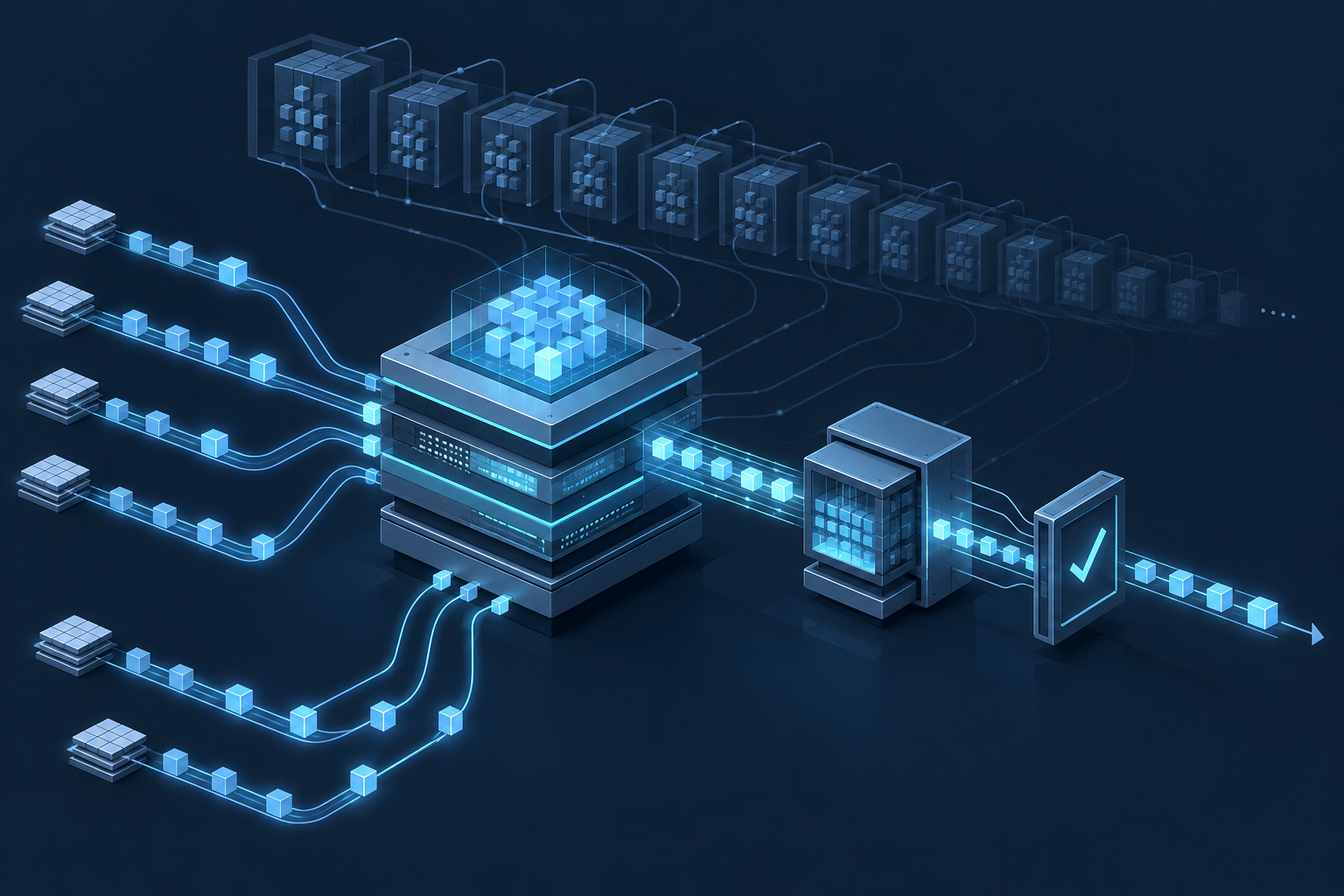
Speculative decoding promises to reduce expensive target-model decoding steps by letting a lightweight draft model propose tokens for verification. But that arrangement becomes harder to sustain when an application continually extends its context. In an agentic session, the draft model must contend with accumulated history while remaining inexpensive enough to justify its role.
DLite addresses this tension by changing how the draft process receives context. Instead of explicitly maintaining its own full historical context, it reuses contextual hidden states from the target model and performs local speculative prediction. The paper, submitted to arXiv on October 16, 2026, and updated on October 19, reports results across general-purpose, long-context, and agentic workloads.[7]
The important development is architectural: DLite treats the interface between draft and target models as an optimization opportunity. Its reported results merit attention, but the available evidence does not establish a production throughput gain. For infrastructure teams, understanding that distinction is central to evaluating the approach.
1. Persistent history changes the economics of speculation
Speculative decoding depends on the target model accepting enough proposed tokens to offset the cost of generating and verifying them. Longer accepted sequences can reduce the number of expensive target-model decoding iterations. When acceptance falls, the draft process becomes less effective at reducing that work.[7]
Agentic workloads put pressure on this relationship. They combine long, continuously evolving contexts with frequent multi-turn interactions. Observations, tool outputs, intermediate plans, and user instructions extend or change the context over the course of a session. The draft model is therefore operating against a moving contextual background rather than only a fixed prompt.
DLite reports that existing draft models experience up to an 80% degradation in acceptance length under these conditions.[7] That is a reported failure mode, not a universal estimate for every agentic application. Nevertheless, it identifies a risk that a stable-context benchmark may not adequately expose: a draft model that initially performs well can become less useful as a session develops.
The brief identifies two related sources of difficulty. The draft model must predict within increasingly large and changing historical context, and maintaining its historical KV cache introduces additional system overhead.[7] The first affects the usefulness of proposed tokens. The second affects the resources required to produce them.
This distinction matters because improving standalone draft-model prediction does not, by itself, establish that the overall system becomes more efficient. A draft process can require cache maintenance, memory traffic, and coordination with the target model in addition to its prediction computation.
The evaluation question is consequently broader than whether the draft model is small or fast. It is whether speculation continues to save work after accounting for evolving context, acceptance behavior, and state-management costs throughout a multi-turn session.
2. DLite changes the draft model's context interface
DLite proposes a history-free speculative decoding framework. Its defining mechanism is to reuse contextual hidden states already produced by the target model, then perform local speculative prediction from those representations.[7]
This changes the draft task. Instead of independently maintaining and interpreting the entire evolving history, the draft component receives context through the target model's representations. The target model has already processed contextual information; DLite uses that work as the basis for local speculation rather than requiring a separate full historical representation in the draft process.[7]
Three properties distinguish the approach:
- No explicit full draft history: The draft process does not explicitly maintain the full historical context.
- Reuse of target representations: Contextual hidden states from the target model provide the contextual interface.
- Local prediction: The draft component performs local speculative prediction rather than processing the entire evolving history.[7]
“History-free” should therefore be read narrowly. It describes the draft process's handling of history, not the elimination of contextual information from inference. The method still relies on contextual representations, but those representations come from the target model. It also should not be interpreted as a claim that the target model's own historical state disappears.
The design addresses the two problems together. Reusing hidden states provides contextual input without an independent historical KV-cache representation for the draft process. Local prediction reduces the requirement for the draft model to model long-range dependencies directly.[7]
For engineers, the conceptual shift is from duplicated contextual modeling toward a shared contextual interface. That is a different optimization axis from quantization or a faster attention kernel. It changes the relationship between the draft and target execution paths, not simply the cost of an individual operation.
The available description establishes this architecture at a high level. It does not provide enough implementation detail to specify how hidden-state reuse is scheduled or what its transfer costs are.
3. The reported results are promising, but narrowly defined
DLite was evaluated on general-purpose, long-context, and agentic workloads. The paper reports acceptance lengths of 2 to 6 tokens across those workload categories.[7] That supports interest in the approach, particularly because its motivation is declining acceptance as history evolves.
However, the available evidence does not explain whether those values represent averages, a range across configurations, or best-case results. It also does not identify the target and draft models, sequence lengths, batch sizes, or hardware configurations. The acceptance figures should therefore remain attached to the paper's reported evaluation rather than being treated as expected deployment behavior.
The comparison with DSpark requires even more care. The paper reports that DLite outperforms DSpark by up to 70%.[7] The available abstract-level result does not identify the metric behind that percentage. It cannot responsibly be relabeled as a throughput improvement, latency reduction, acceptance-length gain, or GPU speedup.
The useful distinction is between three levels of evidence:
| Evidence level | What the available brief supports |
|---|---|
| Workload problem | Existing draft models reportedly lose up to 80% of acceptance length under the described agentic conditions. |
| Method result | DLite reports acceptance lengths of 2 to 6 tokens across the evaluated workload categories. |
| Production outcome | A specific end-to-end latency, throughput, or memory improvement is not established. |
Acceptance length is operationally relevant because verifying several proposed tokens can reduce target-model decoding iterations. It is not sufficient to calculate overall speedup. Draft execution, verification cost, batching, scheduling, memory traffic, and hidden-state reuse overhead all affect the final result.
The strongest defensible conclusion is that DLite proposes a concrete architectural response to a reported acceptance failure mode and presents results supporting further investigation. The evidence does not yet support a precise capacity-planning assumption.
4. Removing draft history shifts the systems questions
DLite's design highlights speculative decoding as a state-management problem. Conventional approaches can require the draft model to maintain a representation of context that the target model has already processed. In long-running sessions, that can duplicate cache maintenance and contextual work.[7]
Avoiding explicit historical state in the draft process could reduce this duplication. But the available evidence does not quantify memory savings, cache traffic reductions, or synchronization costs. Those remain potential benefits to measure, not established deployment outcomes.
The architecture also makes the connection between draft and target execution more important. Reusing hidden states couples the two paths more tightly. For an implementation review, three questions follow from that coupling.
When are the required representations available? The draft process depends on contextual hidden states from the target model. Scheduling must account for that dependency. Acceptance behavior alone cannot reveal whether the resulting execution arrangement is efficient.
Where are those representations located? Memory placement and data movement matter when one component consumes another component's intermediate representations. The brief does not establish whether hidden-state reuse is inexpensive in a particular deployment configuration.
How does the arrangement behave under batching? End-to-end performance depends partly on batching and scheduling. A favorable acceptance result does not establish that the same advantage survives the workload mix and execution policy of a serving system.
These questions do not negate the architectural benefit. They identify where an apparent reduction in draft-state work must be checked against the costs of the replacement interface.
For infrastructure buyers, this is also a useful distinction between a method and an integrated capability. A history-free drafting mechanism may be valuable, but the brief does not identify an implementation repository, license, or deployment-ready integration. It should not be treated as an available production feature without further evidence.
5. How DLite fits into the broader inference picture
Other developments in the brief reinforce the importance of systems behavior, although they address different layers of inference.
“Local Inference of LLMs on Long Contexts: A Data Systems Perspective,” submitted on October 20, 2026, reports that self-attention dominates long-context inference runtime and identifies significant GPU underutilization. It frames KV-cache paging, cache utilization, and GPU synchronization as data-management problems.[4] DLite is more targeted: it proposes a speculative-decoding mechanism rather than a broader diagnosis of long-context execution.
“How Developers Configure LLM Inference: A Large-Scale Study of Real-World Practices,” also submitted on October 20, examines configurations in open-source software using Hugging Face Transformers, vLLM, and the OpenAI API.[2] Its contribution is an empirical view of deployment practice, not a new decoding method in the available description.
The llm-d 1.0 announcement on October 20 describes an open-source project milestone intended to help organizations deploy and scale LLM inference.[9] That is a deployment and systems development, rather than a specific response to acceptance-length degradation.
These distinctions help place DLite correctly. It is neither a general inference platform nor a comprehensive long-context optimization. It targets the cost and predictive limitations of draft history. Its significance lies in connecting that particular workload problem to a redesigned context interface.[7]
6. What an infrastructure evaluation should establish
For teams considering the approach, the next step should be an evidence plan rather than a speedup projection. The brief leaves several variables unspecified, and those variables are necessary to determine whether the method benefits a particular serving environment.
Measure acceptance as sessions evolve. Because DLite targets degradation under persistent history, evaluation should preserve multi-turn behavior rather than reducing the workload to isolated fixed prompts. Track whether acceptance changes as context grows and interactions accumulate. A single aggregate result may not answer the question the method is designed to address.
Connect acceptance to end-to-end outcomes. Measure latency and throughput alongside accepted-token behavior. The goal is to determine whether fewer target decoding iterations translate into a useful serving improvement after draft execution and verification costs are included.
Account for state and data movement. Compare historical draft-cache maintenance with the costs of exposing and reusing target hidden states. Memory consumption, memory traffic, and scheduling overhead are relevant because the architectural proposal changes how context reaches the draft component.
Document the configuration. Target and draft model identities, hardware, batch sizes, and sequence lengths are missing from the available evidence. Any internal evaluation needs to record these conditions so that results can be interpreted and reproduced rather than generalized beyond their scope.
Clarify the baseline comparison. Before using the reported DSpark improvement in a decision, determine which metric the percentage describes and under what conditions it was measured. “Up to 70%” is not a substitute for a defined outcome.[7]
Check implementation availability. The brief does not establish repository status or licensing. Those questions belong alongside performance testing because they affect whether a promising method can become a maintainable part of an inference stack.
These are proposed evaluation criteria, not additional findings from the paper. Their purpose is to bridge the gap between the reported mechanism and a defensible infrastructure decision.
7. What this means for teams running their own inference infrastructure
DLite suggests that speculative-decoding quality and state-management efficiency should be evaluated together. In an agentic workload, the draft model's history can become both expensive to maintain and less useful for prediction. Optimizing only the draft model's execution cost may leave that combined problem unresolved.[7]
For teams operating their own infrastructure, the immediate implication is to examine speculation over the life of a session. If acceptance deteriorates as context evolves, a fixed-context benchmark is an incomplete guide to deployment behavior. The workload's interaction pattern belongs in the evaluation alongside its context length.
The second implication is architectural. Target-model representations may provide a more useful interface for drafting than a separately maintained full history. DLite makes that alternative concrete, but its value still depends on the implementation costs of hidden-state availability, scheduling, and memory placement.
Finally, separate research promise from procurement assumptions. The reported acceptance lengths and DSpark comparison justify investigation, not a guaranteed throughput, memory, or infrastructure-cost reduction. Missing configuration details and an unspecified comparison metric prevent a stronger claim.
DLite's contribution is a focused change in how speculation uses context. For infrastructure teams, the opportunity is to test whether reducing duplicated historical state preserves useful acceptance while improving the complete serving path. The deciding evidence should be sustained end-to-end performance on representative multi-turn workloads, not acceptance length alone.
Sources
- [1]LLM-CoOpt: a co-design and optimization framework for ...
- [2]How Developers Configure LLM Inference: A Large-Scale Study of Real-World Practices
- [3]Exploiting the Flexibility of LLM Inference for Frequency Regulation Service
- [4]Local Inference of LLMs on Long Contexts: A Data Systems Perspective
- [5]Efficient KV Cache Migration for Geo-Distributed LLM Inference in Collaborative Edge Computing
- [6]Prism Attention: Proposal-Refined Index Sharing Mechanism for Efficient LLMs Inference
- [7]DLite: History-free Speculative Decoding for Agentic AI
- [8]LLM-assisted federated Bayesian dynamic graph attention network for ...
- [9]llm-d 1.0 Advances Open, Cost-Efficient AI Inference for ...
Researched from the sources above and fact-checked against them before publishing.
See what this means for your infrastructure.
Book a discovery call and get a benchmark projection for your hardware and model.
SCHEDULE A CALL