
LLM Enhancements
EdgeFlow: Rethinking How KV Caches Move Across Inference Nodes
EdgeFlow combines KV-cache transfer and recomputation to reduce migration time across distributed inference nodes.
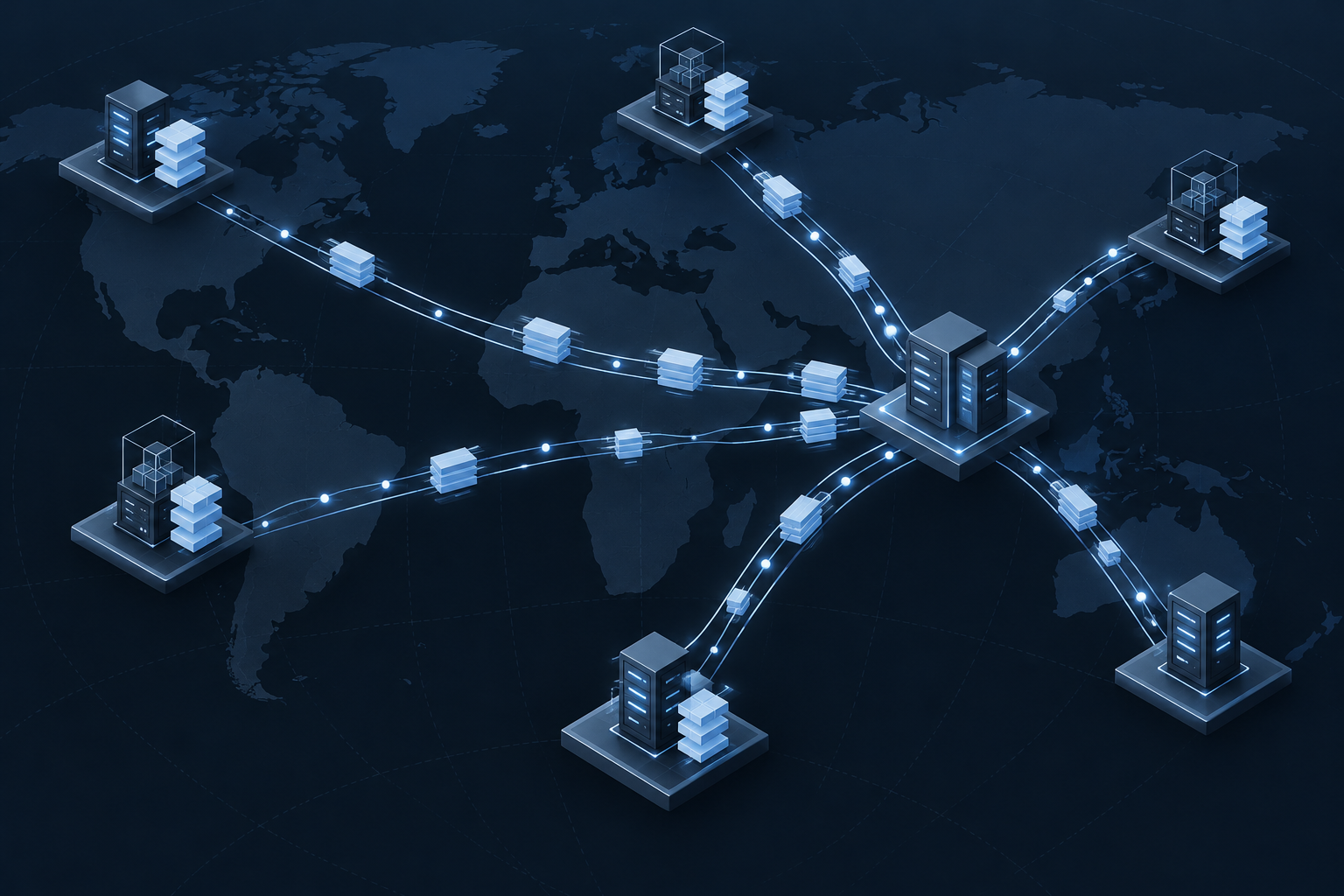
Moving an inference request between nodes means dealing with more than its next token. The destination also needs the attention state accumulated during earlier processing. That state, stored in the KV cache, creates a systems choice: move the cache across the network or regenerate the relevant state through computation. Neither option is always the faster one.[7]
EdgeFlow makes that choice the center of its design. Introduced in Efficient KV Cache Migration for Geo-Distributed LLM Inference in Collaborative Edge Computing, it combines direct KV-cache transmission with activation-based recomputation. Rather than treating migration as a transfer-only operation, it coordinates network and compute resources and exploits parallel execution between them.[7]
The paper reports migration-time reductions of up to 45% on a real-world distributed LLM inference platform. That is a specific result about moving inference state, not a claim of equivalent gains in throughput or end-to-end latency.[7]
For infrastructure teams, the important development is the underlying policy: cached state does not necessarily have to travel in full. Some of it can be transmitted while other portions are regenerated at the destination. Understanding when that division helps requires looking beyond cache size alone.
1. Why KV-cache migration is a separate infrastructure problem
A KV cache stores attention keys and values for tokens that a model has already processed. Keeping those states available avoids recomputing historical attention states for every subsequent token. When the serving location changes, however, the destination may not have the cache associated with the request.[7]
This creates a transition cost that is distinct from ordinary token generation. The system has to provide the destination with the necessary state, either through transmission or recomputation. Optimizing how quickly a node generates tokens does not, by itself, resolve how quickly that node can take over an existing request.[7]
The challenge becomes more pronounced in the geographically distributed setting addressed by EdgeFlow. Cache data can be large, bandwidth can vary, and available compute capacity can differ between locations. A destination with spare compute may be able to regenerate state efficiently even when the network is constrained. A heavily loaded destination may instead favor transmission when its connection is relatively fast.[7]
Those conditions make a fixed migration rule potentially limiting. Always sending the full cache prioritizes avoiding recomputation, regardless of communication cost. Always regenerating the state prioritizes avoiding cache transfer, regardless of destination load. EdgeFlow targets the space between those alternatives.[7]
The scope also matters. This is not primarily a proposal for keeping more cache data in GPU memory or changing how attention reads local state. It addresses what happens when the serving location changes across nodes. For teams evaluating distributed inference, state mobility therefore deserves its own performance analysis rather than being treated as an incidental extension of local cache management.
2. EdgeFlow treats transmission and recomputation as cooperating resources
The paper was submitted to arXiv on October 15, 2026, and updated on October 16, 2026. Its central contribution is a hybrid migration scheme that integrates direct KV-cache transmission with activation-based recomputation, while leveraging parallel communication and computation.[7]
The key distinction is that migration need not be an all-or-nothing choice. Different portions of the state can follow different paths: some are transmitted directly, while others are regenerated at the destination. The policy divides work between resources rather than assuming that every cached value should cross the network.[7]
Consider the resource trade-off qualitatively. When communication capacity is constrained but destination compute is available, recomputation may reduce the amount of data that must be sent. When compute is constrained but communication is relatively inexpensive, transmission may be preferable. A hybrid approach can account for both conditions instead of optimizing one resource in isolation.[7]
Parallelism adds another dimension. The paper explicitly describes overlapping computation and communication to reduce migration time. The relevant question is therefore not only how much work each path performs, but how those paths can proceed together. A plan that divides work without effective overlap would not capture the full systems opportunity described by EdgeFlow.[7]
The available brief does not specify the implementation granularity of this division or the detailed dependencies between transferred and regenerated state. It would be premature to describe a particular partitioning mechanism. What is established is the policy-level contribution: combine transmission and activation-based recomputation, then coordinate their execution.
That framing changes the optimization target. Minimizing bytes transferred is not necessarily the same as minimizing migration time. Neither is minimizing recomputation. EdgeFlow treats the completion of the migration as the outcome that matters.[7]
3. Multi-node scheduling makes the problem more than a local decision
EdgeFlow formulates a multi-node KV migration optimization problem. That matters because the decision is not confined to choosing a migration strategy for one request in isolation. Multiple nodes and competing migration activities can affect how communication and computation should be allocated.[7]
A useful technical interpretation separates three costs. Transmission cost depends on the cache data sent and available bandwidth. Recomputation cost depends on the work required to regenerate activations at the destination. Coordination cost arises when activities compete for resources or when several migrations occur concurrently. This interpretation follows the brief's description of a system that jointly manages communication and computation.[7]
EdgeFlow includes a 2-approximation algorithm based on an improved linear-programming relaxation and bipartite-graph techniques. The approximation result provides a bound relative to the optimum under the paper's stated optimization formulation.[7]
The practical significance is that the work offers more than a general recommendation to balance network and GPU activity. It supplies an algorithmic approach for constructing migration plans within a formal multi-node problem. The combination of optimization formulation and approximation algorithm reflects the difficulty of obtaining globally optimal scheduling decisions in practical distributed settings.[7]
The guarantee still needs careful interpretation. A 2-approximation is not a claim that migration runs twice as fast. It is also not evidence of a universal bound on full-request latency. The available description does not establish whether the guarantee covers the complete practical system or only a formal objective under specific assumptions.[7]
For an engineering evaluation, those assumptions are important follow-up material. Teams would need to understand how closely the formulation matches their resource contention and migration patterns before relying on the mathematical guarantee as evidence of operational behavior.
4. What the reported 45% reduction establishes
The paper reports that EdgeFlow reduced migration time by up to 45% in experiments on a real-world distributed LLM inference platform. This is evidence that hybrid migration can reduce state-movement cost under the evaluated conditions.[7]
Two qualifications are essential. First, “up to” describes a maximum observed improvement, not an average across every workload. Second, the measured outcome is migration time. The result does not establish a 45% improvement in tokens per second, time to first token, or end-to-end request latency.[7]
The available description does not provide evaluated model names, GPU models, cache precision, context lengths, node counts, network bandwidths, baseline implementations, or statistical variance. It also does not supply per-workload results that would show how consistently the method improves on direct transmission or recomputation.[7]
These omissions limit how directly a buyer or operator can translate the headline into a deployment forecast. Without the workload and platform details, the result cannot support a model-independent performance guarantee. Nor can it establish the conditions under which recomputation costs outweigh communication savings.
A practical assessment should distinguish three questions:
- Does the migration itself finish sooner? This is the outcome addressed by the reported result.
- Does the improvement persist across relevant operating conditions? Answering this requires workload-level evidence beyond the maximum reduction.
- Does faster migration improve user-visible service? Establishing this requires measurements across the request lifecycle.
The brief specifically identifies prefill latency, decode throughput, time to first token, inter-token latency, and tail latency as outcomes not reported in the available source. Those metrics would help determine how much of the migration benefit reaches the serving experience.[7]
The evidence is therefore promising but bounded: a measured improvement in one important component of distributed inference, not a complete characterization of serving performance.
5. Migration policy complements cache compression and local management
KV-cache optimization covers several distinct infrastructure concerns. A survey announced by the Hong Kong University of Science and Technology on October 16, 2026, organizes the area into representation and compression, storage and access, and reuse and execution management. It identifies architectural changes, compression, memory management, offloading, and reuse as separate approaches.[9]
EdgeFlow belongs primarily to storage and access and to execution management. It does not primarily introduce a new numerical representation for keys and values. Instead, it addresses how cached state should be transported or regenerated when inference moves to another location.[7]
That distinction prevents an unhelpful comparison between techniques solving different problems. Compression can reduce the amount of state that needs storage or transmission. Migration policy determines how the destination obtains the state and how communication and computation are coordinated. These are related decisions, but they are not interchangeable.[7][9]
The brief describes EdgeFlow as potentially complementary to quantization and compression. A smaller cache could reduce transmission time while leaving a hybrid policy useful for deciding what to transfer and what to recompute. This is a systems possibility, not evidence that a particular combined implementation has been evaluated.[7]
The same distinction applies to local cache-management techniques. Optimizing GPU residency, eviction, or attention access within one serving environment does not directly resolve inter-node migration. EdgeFlow addresses the additional distributed decision involving serving location and state movement.[7]
For infrastructure comparisons, the useful question is consequently not which approach replaces all the others. It is which cost each approach targets. Representation, residency, and migration can each affect the handling of cached state, and evidence for one should not be presented as proof of improvement in another.
6. How to evaluate hybrid migration for a deployment
The most relevant starting point is whether requests actually move between inference nodes. EdgeFlow is designed for the transition in which the destination must receive or reconstruct an existing KV cache. Systems serving long-running or stateful requests may benefit when those requests relocate, but the available evidence does not establish a benefit independent of migration activity.[7]
For a team considering a trial, the evaluation should mirror the resources the method coordinates. Network conditions and destination compute availability both deserve attention. Testing only a favorable bandwidth condition or only an otherwise idle destination would leave the central trade-off incompletely examined.
A useful evaluation plan would compare direct transmission, recomputation, and hybrid migration under conditions representative of the team's deployment. It should make the model, context length, cache precision, hardware, network conditions, and concurrent activity explicit. These are proposed evaluation requirements, not details supplied for the paper's reported platform.
Concurrency also deserves deliberate treatment. Because EdgeFlow addresses a multi-node optimization problem, isolated request tests would not fully examine behavior when migrations compete for resources. Teams should investigate both individual migration completion and the effect on other serving activity.
Finally, migration measurements should be paired with request-level measurements. A shorter migration is valuable evidence, but the operational question is whether that improvement reaches the user without creating an unacceptable cost elsewhere. Prefill latency, decode throughput, time to first token, inter-token latency, and tail latency provide a broader assessment than migration time alone.[7]
This approach preserves the paper's contribution without assuming its maximum reported gain will transfer unchanged to another environment. It also turns missing experimental detail into a concrete validation agenda rather than a reason either to dismiss or overstate the method.
7. What this means for teams running their own inference infrastructure
EdgeFlow broadens the KV-cache discussion from local memory efficiency to distributed state mobility. Its contribution combines direct transmission, activation-based recomputation, overlapping communication and computation, and a 2-approximation algorithm built on linear-programming relaxation and bipartite-graph techniques.[7]
For teams operating their own infrastructure, the immediate takeaway is to treat migration as a distinct part of the serving system. If requests move across nodes, the cost of making their history available at the destination should be measured explicitly. Token-generation performance alone does not characterize that transition.
The second takeaway is to avoid assuming that either bandwidth or compute must always carry the entire migration burden. EdgeFlow provides evidence for a hybrid alternative in which the two resources cooperate. Whether that alternative is worthwhile depends on deployment conditions that the available brief does not fully specify.[7]
For infrastructure buyers, the corresponding requirement is workload-specific evidence. Ask for the migration baseline, resource conditions, behavior under concurrent activity, and effects on full-request performance. A maximum migration-time reduction is useful, but it is not a substitute for those answers.
The reported improvement of up to 45% makes EdgeFlow a focused development worth examining, not a universal serving-performance guarantee.[7] Its broader lesson is that distributed inference must optimize not only where requests execute, but also how their existing state becomes usable at the next node. Transmission and recomputation belong in the same decision.
Sources
- [1]LLM-CoOpt: a co-design and optimization framework for ...
- [2][2610.17586] High-Throughput LLM-Based Compression and What ...
- [3]Scaling LLM Inference via Parallelism: Throughput-Latency Trade-off
- [4]Fractional Power-of-Two Quantization for Efficient and Effective Multiplier-Free LLM Inference
- [5]Stable Token-level Scheduling for Serverless LLM Inference
- [6]Energy Consumption Analysis of Discrete Diffusion and Autoregressive Language Models
- [7]Efficient KV Cache Migration for Geo-Distributed LLM Inference in Collaborative Edge Computing
- [8]Compositional Performance Modeling of LLM Inference Clusters with Hierarchical KV Caching
- [9]KV-Cache Infrastructure Optimization for LLM Inference Systems
- [10]Smells Like Prompt Spirit: Evaluating Energy Efficiency and Performance of Local LLM Inference on CPU vs GPU
Researched from the sources above and fact-checked against them before publishing.
See what this means for your infrastructure.
Book a discovery call and get a benchmark projection for your hardware and model.
SCHEDULE A CALL