
LLM Enhancements
GPU-Resident Speculative Decoding: A Systems Approach to Faster Browser Inference
A WebGPU paper reports substantial decoding gains over WebLLM, highlighting GPU residency as a practical inference optimization.
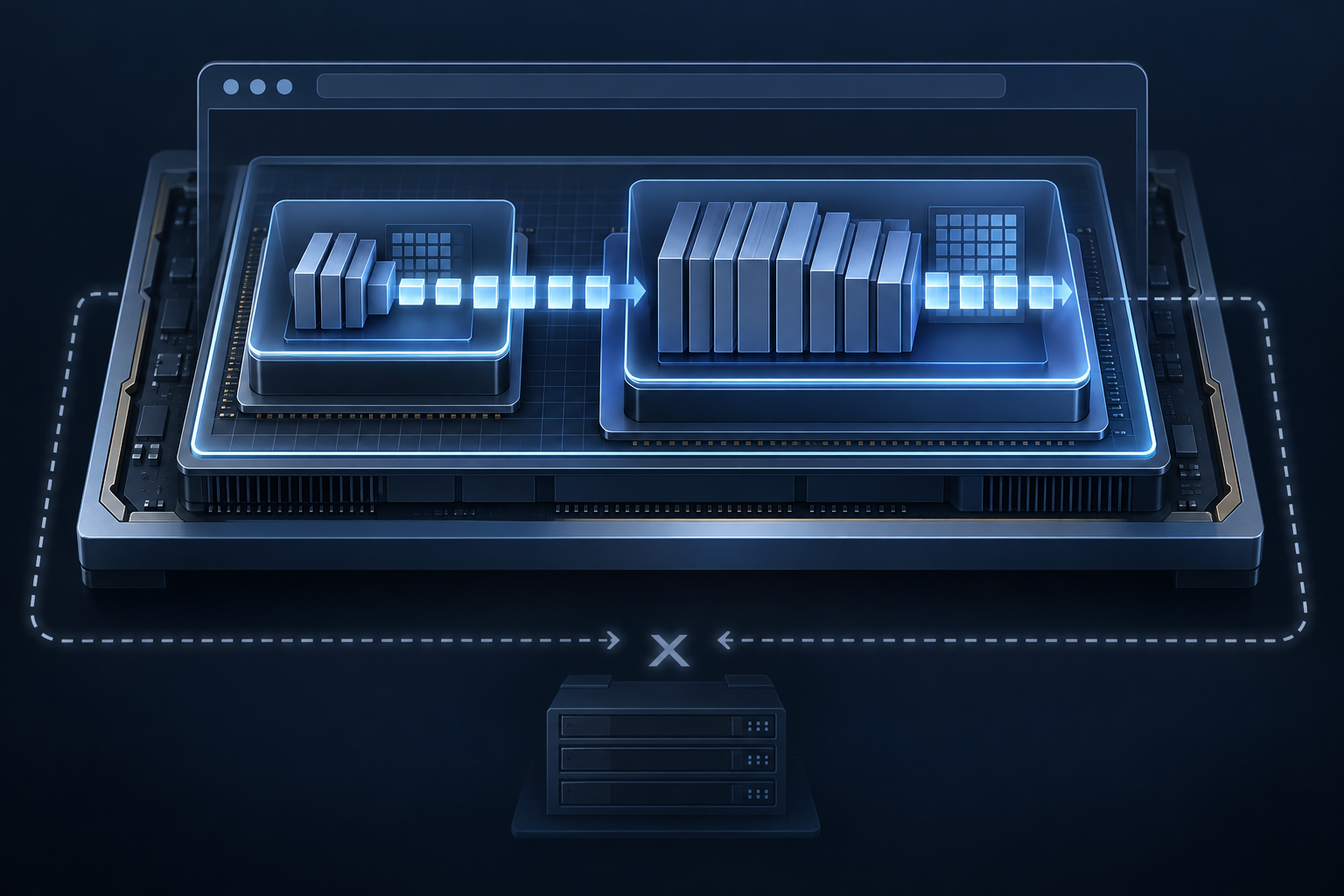
Speculative decoding promises faster generation by letting a smaller model propose tokens for a larger model to verify. In a browser, however, the algorithm is only part of the performance equation. Moving proposals and intermediate state between JavaScript, WebGPU, and GPU memory can consume enough time to undermine the expected gain.
A paper titled “GPU-Resident Speculative Decoding for In-Browser LLM Inference with WebGPU” addresses that systems problem directly. Submitted to arXiv on October 29, 2026, and updated on October 30, it reports substantial decoding improvements over WebLLM across seven models, 11 tasks, and three client GPUs. The reported speedups range from 3.5 to 8.6 times, depending on hardware category and evaluated configuration. [2]
The result matters because it connects an algorithmic optimization to its execution environment. Choosing an effective draft model is not enough if coordination and data movement dominate the speculative pipeline. For engineers and infrastructure buyers, the useful question is therefore not simply whether speculative decoding works. It is whether the runtime preserves its advantage through the complete decoding path, and whether the available measurements establish that advantage for the intended deployment.
1. Browser inference changes the speculative decoding bottleneck
Conventional autoregressive generation produces tokens through repeated model execution. Speculative decoding changes that sequence: a smaller draft model proposes multiple candidate tokens, and the target model verifies them. When the target accepts several candidates in a verification step, the system can reduce the number of expensive target-model decoding iterations.
That opportunity comes with additional work. The draft model must generate proposals, the target must verify them, and the runtime must coordinate both operations. Memory movement and synchronization affect the final result alongside model execution. A strong proposal mechanism does not automatically produce a strong end-to-end implementation.
Browser inference makes this distinction especially important. Execution passes through WebGPU, requires GPU command submission, and must coordinate model work within a browser runtime. The paper targets the overhead associated with transferring draft tokens and intermediate state across JavaScript, WebGPU, and GPU memory. Those transfers can erase much of the theoretical benefit of speculative decoding. [2]
This reframes the optimization problem. Draft-model quality remains relevant because acceptance determines how many proposed tokens become useful output. But acceptance is not the only variable. A pipeline that generates good proposals can still spend too much time moving or coordinating them.
For practitioners, the implication is to examine the complete speculative step rather than treating proposal generation and verification as independent performance wins. The relevant output is useful decoded tokens over elapsed time, including the runtime work needed to produce them. That is why the paper's reported end-to-end decoding comparison is more informative than an isolated kernel-speed claim. It evaluates the outcome of the runtime design rather than only one accelerated operation. [2]
2. GPU residency is the central design choice
The paper's central systems choice is to keep speculative-decoding work GPU-resident instead of repeatedly moving intermediate state through host-side execution paths. At a conceptual level, this places draft proposals, verification inputs, and associated coordination closer to the accelerator execution path. [2]
The distinction is about the pipeline, not just the location of model computation. Running models on a GPU does not by itself resolve the cost of moving intermediate results through CPU-managed code between operations. The research brief identifies that boundary crossing as the problem the proposed runtime addresses.
A useful way to understand the design is to separate logical work from execution overhead. Logically, the system still needs candidate generation and target verification. GPU residency seeks to organize that work so that the surrounding movement and coordination do not consume the benefit gained from accepting multiple draft tokens.
The available evidence does not establish exactly how the runtime achieves this. It does not identify whether kernel fusion, GPU-side acceptance logic, reduced synchronization, persistent buffers, or another mechanism accounts for the largest share of the improvement. None of those implementation details should be inferred from the title or speedup ranges. [2]
That limit matters when translating the research into an engineering plan. “Keep the pipeline GPU-resident” is a useful direction, but it is not a complete implementation specification. Teams still need to understand which state remains on the GPU, which transitions remain necessary, and how the execution path is coordinated.
The reported results support investigating residency as a runtime strategy. They do not isolate the contribution of every design decision. Distinguishing those claims prevents a broad architectural lesson from becoming an unsupported claim about a particular optimization mechanism.
3. What the reported benchmarks establish
The evaluation covers seven models ranging from 0.5B to 8B parameters, 11 tasks, and three client GPUs representing laptop, integrated, and workstation categories. The paper reports the following decoding speedups relative to WebLLM. [2]
| Hardware category | Reported decoding speedup over WebLLM |
|---|---|
| Laptop GPU | 3.5 to 5.4 times |
| Integrated GPU | 4.8 to 6.2 times |
| Workstation GPU | 4.8 to 8.6 times |
These are end-to-end comparative decoding results reported in the abstract, not measurements of an isolated kernel. That distinction makes them relevant to runtime evaluation: the claim concerns the realized decoding outcome rather than the potential contribution of one component. It should not, however, be expanded into a claim about complete application response time. [2]
The workstation GPU has the highest reported upper bound, at 8.6 times faster than WebLLM. The integrated GPU also shows a substantial range, with both its lower and upper bounds exceeding the corresponding laptop-GPU bounds. This demonstrates that the reported benefit was not confined to the workstation category. It does not establish that the integrated GPU delivered higher absolute throughput than the laptop GPU. [2]
The model and task coverage also matters. Seven models spanning 0.5B to 8B parameters provide broader evidence than a single small-model demonstration. Eleven tasks provide additional evaluation breadth. Nevertheless, the available excerpt does not identify the models or tasks, so it cannot show which architectures or workload characteristics benefit most. [2]
The defensible conclusion is specific: across the reported evaluation, the proposed runtime decoded substantially faster than WebLLM on all three tested client-GPU categories. The evidence supports the design direction across those tested environments, while leaving the distribution of results and configuration-level explanations unresolved.
4. Relative speedup is not a deployment specification
The headline ranges are compelling, but a speedup ratio answers a narrower question than an infrastructure team typically needs to ask. It describes performance relative to a baseline. Without the baseline's absolute decoding rate, the ratio does not reveal the resulting tokens per second.
The available abstract excerpt does not provide absolute throughput, exact model names, acceptance rates, batch sizes, prompt lengths, or the WebLLM software version. These omissions limit how precisely a team can map the reported results onto its own deployment. [2]
Hardware comparisons require similar care. A larger improvement over WebLLM on one GPU does not establish that the device is faster than another GPU in absolute terms. The reported integrated-GPU range therefore cannot be used to rank integrated and laptop hardware for a procurement decision. It shows relative improvement within the reported comparison, not a cross-device throughput ranking.
The baseline also defines the scope of the claim. These results establish an advantage over WebLLM in the evaluated setting. They do not establish the same advantage over every browser inference runtime, and they do not provide a direct comparison with native inference stacks. [2]
For buyers, this distinction changes how the benchmark should enter an evaluation. The results are a reason to investigate a GPU-resident browser runtime, not a substitute for testing a candidate configuration. A purchase or deployment decision still requires measurements against the software and hardware the team actually intends to use.
The most useful reading is therefore neither to dismiss the ratios nor to treat them as universal. They are substantial reported improvements with a defined comparator and incomplete configuration detail. Preserving both parts of that statement keeps the result technically meaningful without turning it into an unsupported performance guarantee.
5. Important operational questions remain unanswered
Decoding speed is only one dimension of inference performance. The reported ranges do not establish GPU memory consumption, energy efficiency, first-token latency, long-context behavior, or quality preservation. The available source does not provide corresponding measurements for those properties. [2]
First-token latency deserves separate treatment. A faster decoding phase does not, by itself, establish a shorter wait before generation begins. Teams with interactive requirements should therefore evaluate the start of the response separately from its subsequent generation rate. The paper's available headline results answer the latter question, not the former.
Memory is another unresolved dimension. The brief does not quantify the proposed runtime's GPU memory footprint or memory overhead. Consequently, the speedup ranges cannot determine whether a particular model configuration fits a team's client-device constraints. GPU residency is a design direction, not evidence of lower memory consumption.
The task coverage leaves additional questions. Although the evaluation includes 11 tasks, the available excerpt provides neither their identities nor task-by-task measurements. It also does not report acceptance-rate distributions. Teams cannot use the headline ranges to determine which workloads produce the most favorable proposal and verification behavior. [2]
Quality requires the same evidentiary discipline. The available results report decoding speedups, but they do not independently establish quality preservation. That is an unresolved measurement question in this evidence, not evidence that quality was reduced.
Finally, the research currently rests on a single arXiv paper. Its cross-model and cross-device evaluation is useful, but that breadth should not be confused with independent replication. The appropriate response is targeted validation: identify which missing measurements affect the intended deployment, then obtain or reproduce them before making broader operational claims.
6. How to evaluate the approach in your own environment
The research suggests a practical evaluation strategy centered on the complete decoding path. The first step is to define a comparison that reflects the deployment under consideration: the models, tasks, client devices, and baseline runtime that the team would otherwise use. The paper's WebLLM comparison is informative, but it should not silently stand in for a different production baseline.
Record absolute decoding throughput alongside relative speedup. This allows the team to answer both whether the candidate runtime improves performance and whether the resulting performance meets its requirements. Keep first-token latency separate so that a decoding improvement does not obscure a different response-start behavior.
Configuration detail should be part of the result, not an afterthought. Model identity, parameter scale, prompt length, batch size, software version, and hardware identity are all relevant items to document. Their absence from the available excerpt is precisely why the published ranges cannot yet serve as a reproducible deployment specification.
The systems investigation should then follow the speculative pipeline. Examine proposal generation, target verification, data movement, and synchronization together. Where measurement is possible, distinguish useful model work from time spent coordinating execution. This follows the paper's central lesson without assuming which implementation mechanism produced its gains.
A focused validation checklist is:
- Measure absolute decoding throughput and relative improvement against the chosen baseline.
- Track first-token latency separately from decoding speed.
- Record GPU memory use for each evaluated model and device configuration.
- Examine acceptance behavior and task-level performance where available.
- Check output quality rather than treating speed as evidence of preservation.
- Document software versions and workload settings so comparisons remain interpretable.
These are proposed evaluation requirements, not additional results from the paper. Their purpose is to turn a promising reported architecture into evidence suitable for an engineering or purchasing decision.
7. What this means for teams running their own inference infrastructure
For teams operating browser-based inference, GPU-resident speculative decoding is a concrete optimization direction worth evaluating. The reported gains cover multiple model sizes, tasks, and client-GPU categories, making the work relevant beyond a single-device demonstration. The strongest supported claim remains the specific one: substantially faster decoding than WebLLM across the reported evaluation. [2]
For teams running native or server-side infrastructure, the transferable lesson is architectural rather than numerical. The paper does not establish that its speedup ranges carry over to those environments. It does reinforce the need to evaluate algorithmic acceleration together with proposal generation, verification, memory movement, and synchronization.
That distinction is important when comparing inference performance layers. A feature label such as “speculative decoding” says little about how efficiently the surrounding runtime executes it. Infrastructure buyers should ask for measurements that include the complete decoding path and expose the configuration behind the result. Engineers should investigate whether intermediate-state movement is limiting the benefit of an otherwise effective algorithm.
The paper does not settle questions about memory, energy, output quality, or first-token latency. It does provide a focused reason to look harder at GPU residency in WebGPU inference. For teams controlling their own runtime choices, the next step is not to adopt the largest headline multiplier as a forecast. It is to test whether keeping speculative work close to the GPU improves the workloads and devices they actually support, while measuring the operational properties the headline benchmark leaves open.
Sources
- [1]MCF: A Memory- and Communication-Aware Co-Designed Framework for Long-Context LLM Inference
- [2]GPU-Resident Speculative Decoding for In-Browser LLM Inference with WebGPU
- [3]p-DCIM: A 28nm Probabilistic SRAM DCIM based Ising Machine for Near-Memory Context Selection in LLM-RAG Pipeline
- [4]Self-Indexing Attention: One Sign Field for Retrieval and Compression | Zhongzhu (Charlie) Zhou
- [5]Request-Adaptive Execution for Efficient Hybrid LLM Inference
- [6]Post
- [7]Less is more: learning what to profile for GPU kernel ...
- [8]Beyond the LLM Token: Shifting Generative AI Spend to ...
- [9]Project Maya v1.1.28 Speeds Up DeepSeek on a Single Linux NVIDIA GPU, Adds 1M Context
- [10]PRISM: Prompt representation internalization via selective compression into LoRA weights
Researched from the sources above and fact-checked against them before publishing.
See what this means for your infrastructure.
Book a discovery call and get a benchmark projection for your hardware and model.
SCHEDULE A CALL