
LLM Enhancements
MCF Makes KV-Cache Placement a Stage-Specific Inference Decision
MCF combines temporary KV replication with query-centric decode to address communication costs in distributed long-context inference.
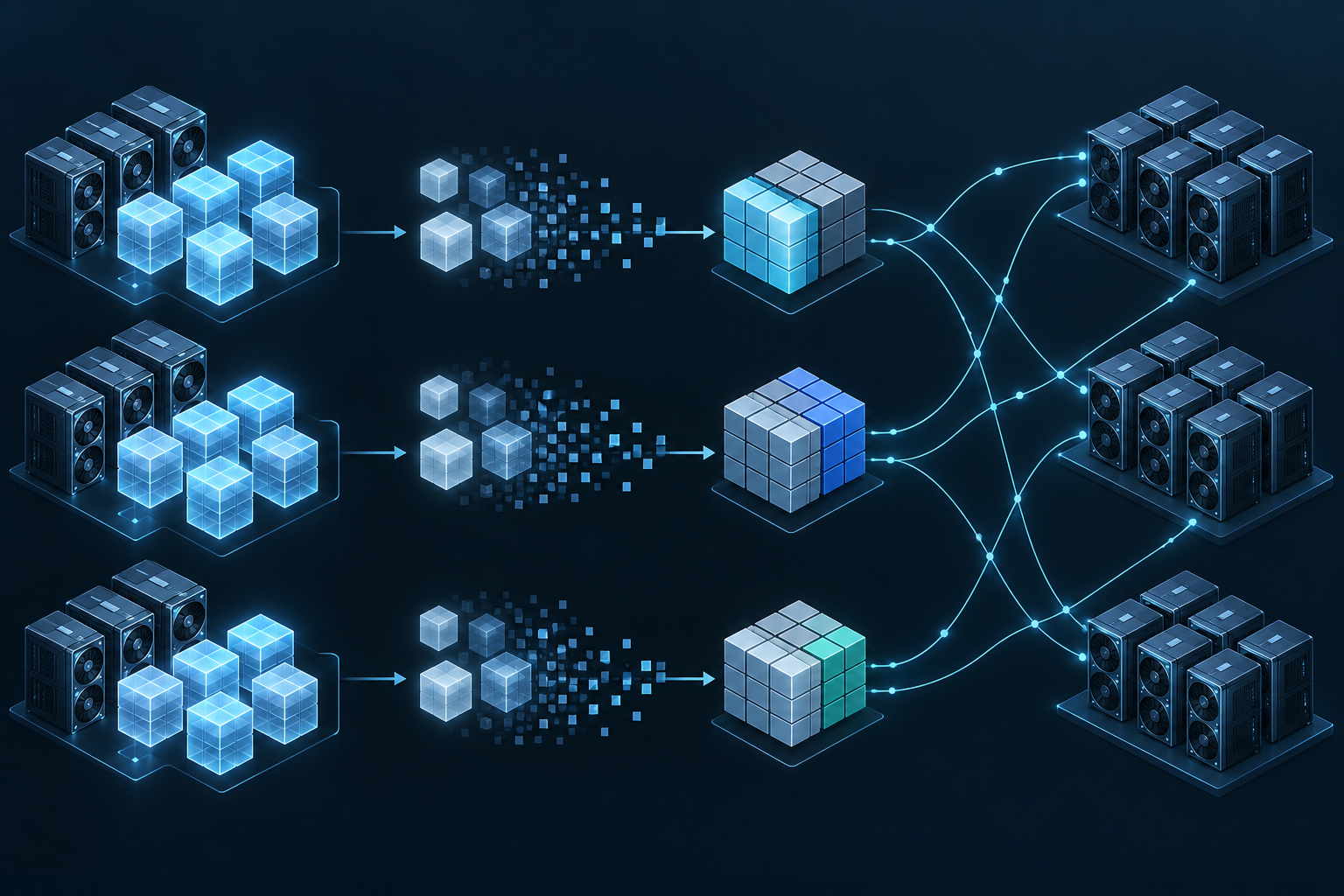
Long-context inference creates two related infrastructure problems: storing a growing KV cache and making that cache available where attention executes. Adding distributed memory can address capacity, but it does not eliminate the cost of moving data between GPUs or inference workers. As context grows, cache placement becomes part of the execution strategy, not just a memory allocation decision.[3]
MCF, short for Memory- and Communication-Aware Co-Designed Framework for Long-Context LLM Inference, tackles these problems together. Submitted to arXiv on October 26, 2026, and updated on October 28, it proposes changing KV-cache organization across inference stages. Early prefill uses available memory for selective replication. Later prefill removes redundant copies. Decode keeps KV shards stationary and routes queries to the workers holding them.[3]
The contribution is architectural: choose which data to replicate, which data to keep stationary, and when to change placement. For infrastructure teams, the important question is whether this coordinated strategy can reduce communication without creating a costly transition between processing a prompt and generating its response.
1. Long Context Turns Cache Placement Into a Communication Problem
A KV cache is not only a collection of stored attention state. In distributed inference, it is also data that must be accessible across execution workers. The research brief identifies cache growth and the cost of transferring or redistributing KV blocks as connected constraints. A system can have enough aggregate memory to hold a context while still spending substantial effort making the relevant data available where it is needed.[3]
That distinction matters because capacity and locality are different objectives. Sharding distributes the cache, while replication can place additional copies closer to computation. Replication consumes memory; fetching remote blocks consumes communication resources. MCF treats these as a coordinated placement problem rather than optimizing one in isolation.[3]
The balance also changes during inference. Prefill processes many input tokens and can exploit available computation and memory. Decode repeatedly accesses the accumulated KV cache while producing one or a small number of new tokens. A cache organization selected for one phase therefore need not be the best organization for the other.[3]
Conventional distributed approaches often retain a fixed placement or explicitly convert layouts between phases. MCF instead makes layout a runtime-stage decision. Its objective is to obtain the locality benefits of replication when memory permits, then arrive at a sharded organization suited to decoding without retaining the extra copies.[3]
For engineers, this broadens the optimization question. Reducing the cache footprint remains useful, but footprint alone does not describe the cost of serving it. Where the cache resides, how often blocks cross worker boundaries, and how placement changes during a request are separate dimensions worth evaluating.
2. MARS Uses Spare Prefill Memory to Improve Locality
MCF's prefill mechanism, MARS, selectively replicates highly reused KV blocks while early-stage memory headroom is available. The purpose is to improve locality and hide KV-propagation latency behind attention computation. Rather than immediately committing every block to a purely sharded arrangement, the framework temporarily spends additional memory to reduce data-movement delays.[3]
The selectivity is important. The described mechanism targets highly reused blocks, not permanent replication of the entire cache. Its rationale depends on both available headroom and block reuse: an extra copy is useful when it reduces the need to fetch data remotely during prefill. The framework consequently treats spare memory as a resource that can support communication optimization.[3]
This is a different objective from minimizing allocated cache memory at every instant. Under MCF's design, a larger temporary footprint can be useful if it improves locality while attention computation proceeds. Memory efficiency is evaluated across the inference stages rather than solely by the number of copies present during early prefill.[3]
That trade-off cannot remain unchanged as the prompt is processed. The cache grows, memory pressure rises, and the space available for redundant data becomes more constrained. MARS progressively drains replicas as prefill advances, converging toward a sharded, decode-ready layout.[3]
The resulting policy has three stages: replicate selected blocks while headroom is available, remove redundancy as pressure increases, and finish with the placement needed for decode. Each stage serves a different operational purpose.[3]
For an implementation review, the relevant questions follow directly from this trade-off. Teams should examine available prefill headroom, the reuse of replicated blocks, and the behavior of replica removal under their workloads. The available excerpt establishes the strategy, but it does not provide enough detail to prescribe deployment settings or quantify how much memory replication requires.
3. The Prefill-to-Decode Boundary Is Part of the Optimization
A prefill layout can be efficient on its own and still create work before generation begins. If decode expects a different cache organization, the system may need to rearrange accumulated state after prompt processing. That transition can add latency before the first generated token, reducing the benefit of faster prefill execution.[3]
MCF explicitly targets this boundary. The paper states that progressively removing replicas avoids an expensive layout conversion between prefill and decode. Instead of retaining the prefill organization until the phase ends, the framework moves toward the decode-ready layout while prefill is still progressing.[3]
This makes the transition part of the execution policy rather than a separate cleanup step. Early replication and later de-replication are not independent optimizations: they are successive parts of a plan for reaching the final placement. The temporary layout is useful only if the system can leave it without imposing an expensive conversion at the boundary.[3]
The distinction matters when interpreting time to first token, or TTFT. A prefill-only improvement does not establish that a user will receive the first generated token sooner if cache rearrangement follows. MCF reports TTFT improvements, and its stated mechanism includes avoiding that boundary cost.[3]
However, avoiding an expensive boundary conversion should not be read as proof that all layout maintenance is free. The excerpt describes progressive replica removal but does not provide a numerical breakdown of its overhead. An evaluation should therefore measure the complete path to the first token and account for layout-management work wherever it occurs.
The broader engineering lesson is to examine phases together. Optimizing prefill and decode separately can miss the cost of handing state from one to the other. MCF makes that handoff an explicit design concern.[3]
4. Query-Centric Decode Keeps the Large Cache Stationary
Once decoding begins, MCF changes the communication pattern. KV shards remain stationary, and lightweight query tensors are routed across workers. The paper calls this a query-centric execution model and describes it as moving from KV-cache-dependent transfer to query-dependent transfer.[3]
The distinction is straightforward: route the query toward the relevant cache shards rather than move KV data in response to each decode operation. The accumulated cache can be large for a long prompt, whereas the query associated with a decode step remains comparatively small. Keeping the larger state in place targets the communication cost associated with repeatedly accessing that state.[3]
This does not mean that distributed decoding becomes communication-free. Query tensors still travel between workers. The claim is about what moves and how communication grows with context length, not the elimination of inter-worker traffic. The available excerpt does not provide a complete accounting of all decode communication.[3]
MCF claims reduced communication growth as contexts expand. Its mechanism supports that direction: routing a comparatively small query avoids repeatedly transmitting cache data whose volume scales with the full context. That is a narrower and more useful interpretation than assuming total communication is independent of context or cluster size.[3]
This decode strategy also explains why the earlier layout transition matters. MARS uses replication to help prefill, but the framework does not preserve that memory cost throughout generation. It converges toward stationary shards that support query routing. Prefill placement and decode execution are therefore designed as parts of one strategy.[3]
For infrastructure evaluation, the central measurement question becomes whether the changed traffic pattern improves the complete serving workload. Cache capacity, communication volume, TTFT, and throughput should be considered together. A reduction in KV movement is an important mechanism, but the reported system-level benefits still need validation on the intended deployment.
5. The Performance Claims Need a Clear Evidence Boundary
The MCF abstract reports improvements in TTFT, throughput, and scalability compared with state-of-the-art distributed inference systems. It also states that the benefits become larger as context length and cluster size increase. These are the reported performance claims available in the research brief.[3]
The excerpt does not provide numerical speedups, GPU counts, model names, benchmark datasets, or tested context lengths. It therefore cannot support a specific acceleration figure, a recommended cluster size, or a cost-saving estimate. Nor does it establish which operating conditions produce the largest practical benefit.
The scaling claim is consistent with the proposed mechanism. Longer contexts increase KV-cache volume, making cache-dependent movement more consequential. Larger clusters can increase the potential cost of distributed coordination and data movement. MCF addresses these factors through stage-adaptive placement and query-centric decode.[3]
Mechanistic consistency is not a substitute for measurements, however. It explains why the design is worth evaluating, not how much faster it will run on a particular installation. Infrastructure buyers should distinguish an architectural argument from an independently usable performance estimate.
A useful evaluation would separate the questions that the abstract groups together:
- Does the full prefill-to-first-token path become faster, including layout-management work?
- Does decode throughput improve with stationary KV shards and query routing?
- How does temporary replication affect memory availability during prefill?
- Do the benefits persist across the context lengths and cluster sizes the team actually uses?
These are evaluation questions, not results reported by the excerpt. Until the underlying measurements are available, MCF is best understood as a concrete systems design with reported performance benefits whose magnitude and deployment scope remain unquantified in the supplied material.[3]
6. Placement Optimization Is Different From Cache Compression
MCF sits alongside, rather than replaces, work on reducing KV-cache representation size. Its primary emphasis is distributed placement and communication across prefill and decode. It does not depend on quantizing or approximating cached values.[3]
GAAC, the Group-Adaptive Additive Codec, addresses a different part of the problem. Submitted on October 28, 2026, it proposes lossless KV compression based on exponent redundancy. The brief reports decode-attention acceleration of 1.19 to 1.27 times at a 64K-token context on NVIDIA DGX Spark, and end-to-end W4A16 decode-step acceleration of 1.04 to 1.15 times.[5]
Those figures belong to GAAC's reported evaluation, not MCF. They should not be transferred to distributed placement or treated as a direct performance comparison. GAAC targets storage and attention cost through compression; MCF changes where cache data resides and which tensors move between workers.[3][5]
The approaches are potentially complementary. A system could, in principle, compress cached data while also selecting when to replicate it, when to shard it, and where to route queries. However, the available sources do not report an integrated evaluation combining MCF and GAAC. Any combined benefit remains a possibility, not a measured result.
The paper KV Cache Quantization for Diffusion Language Models addresses another distinct setting. Submitted on October 29, 2026, it introduces TRACE and dLLM-KVQ for iterative masked decoding, where reused KV states can differ from full recomputation as masked tokens are revealed.[1]
The practical distinction is the optimization target. Representation methods change how cached information is stored. MCF changes its placement and access pattern. Teams should identify which constraint they need to address before treating these methods as alternatives.
7. What MCF Means for Teams Running Their Own Inference Infrastructure
For teams operating distributed inference, MCF suggests treating KV-cache management as a phase-specific systems problem. The relevant decisions extend beyond whether a model and its context fit in memory. They include whether temporary copies improve locality, whether those copies can be removed as pressure rises, and whether decode can reach stationary shards through query routing.[3]
The immediate takeaway is an evaluation framework, not a deployment mandate. Start by examining the full request path. Identify where KV data moves during prefill, whether the cache is rearranged before generation, and what communication occurs during decode. These observations can help determine whether MCF's targeted bottlenecks resemble those of the existing system.
Next, assess the replication trade-off explicitly. MARS relies on memory headroom and reuse to justify extra copies. A review should consider both the locality benefit and the process of draining replicas, rather than assuming that replication is always beneficial or that a fully sharded layout is always preferable.[3]
For purchasing and capacity planning, maintain the same evidence discipline. The supplied material does not establish a GPU reduction, a cost-per-token improvement, or a numerical throughput gain for MCF. Such conclusions require measurements on relevant models, contexts, and infrastructure. Reported scaling benefits provide a reason to investigate, not a substitute for that work.
MCF's clearest contribution is to coordinate decisions that can otherwise be evaluated separately: early prefill replication, later replica removal, the prefill-to-decode transition, and decode-time communication. Its architecture spends memory temporarily to improve locality, then keeps the accumulated cache stationary while moving queries.[3]
For long-context infrastructure, that is a useful design principle: optimize not only how much KV state exists, but where it lives and when it needs to move. MCF turns that principle into a specific execution strategy, with reported benefits that warrant careful, workload-specific validation.
Sources
- [1]KV Cache Quantization for Diffusion Language Models
- [2]Request-Adaptive Execution for Efficient Hybrid LLM ...
- [3]MCF: A Memory- and Communication-Aware Co-Designed Framework for Long-Context LLM Inference
- [4]KV Cache Wars: How Compaction, Quantization, and a ...
- [5]GAAC: Lossless KV Compression for Bandwidth-Efficient LLM Inference on Personal Devices
- [6]Raincheck: Deferred Multimodal Prefill for Efficient Multi-Turn MLLM Inference
- [7][2610.39275] LLM-Assisted Optimization for Simulation-Based ...
- [8]vLLM vs SGLang vs TensorRT-LLM: Picking an Inference Server
- [9]EdgePace: Deadline- and Freshness-Aware LLM Scheduling on Unified-Memory Platforms
- [10]NyoomFloat12: How a 12-Bit Fixed-Length Format Doubles LLM Inference Throughput Without Losing a Single Bit
Researched from the sources above and fact-checked against them before publishing.
See what this means for your infrastructure.
Book a discovery call and get a benchmark projection for your hardware and model.
SCHEDULE A CALL