
LLM Enhancements
Parallel Drafting Targets the Waiting Time Inside Speculative Decoding
Parallel drafting targets verifier idle time, shifting speculative decoding toward pipeline efficiency rather than acceptance rate alone.
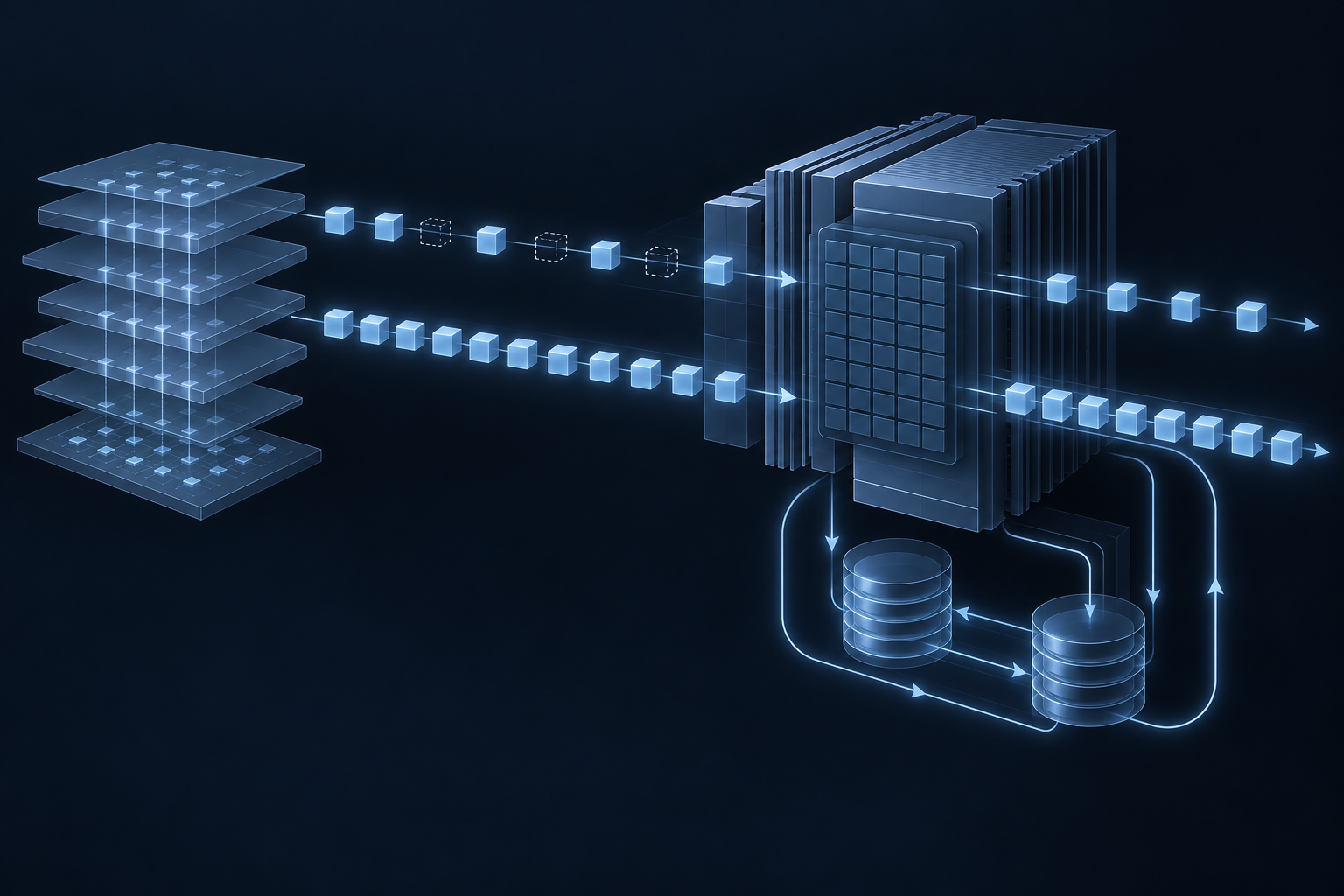
Speculative decoding promises to make a large language model do less expensive sequential work. A smaller draft model proposes candidate tokens, and a larger target model verifies them in parallel. When several candidates are accepted in one verification pass, the system can reduce the number of target-model decoding steps needed to generate an answer.[1]
But fewer verification passes do not automatically mean a well-utilized inference pipeline. Before the target model can verify a candidate sequence, the draft model has to produce it. If drafting remains sequential, the verifier waits. The smaller model can therefore become a recurring dependency on the critical path, even when it is comparatively inexpensive to run.[1]
“Cannot Wait to Verify: Parallel Drafting to Eliminate Verifier Idle Time in Speculative Decoding,” submitted on November 20, 2026, and updated on November 23, proposes an adaptive drafting method aimed at that waiting period. Its central mechanism is parallelizing draft inference across Transformer layers, with a cache-restoration step to prevent approximation errors from accumulating.[1]
For infrastructure teams, the important shift is in the optimization target: not just how many tokens the verifier accepts, but how promptly the pipeline supplies work for it to verify.
1. The bottleneck between drafting and verification
The basic speculative-decoding workflow creates a dependency between two different kinds of computation. The draft model generates a sequence of candidates. The target model then evaluates those candidates in parallel, potentially accepting multiple tokens during a single pass.[1]
This arrangement improves verification efficiency when it replaces several expensive target-model decoding steps with one verification pass. However, it also creates an interval in which the verifier cannot process the next candidate block because that block is not ready. The paper identifies sequential draft generation as the source of this waiting period.[1]
That distinction matters when interpreting speculative-decoding results. Acceptance length describes how much useful output a verification pass produces. It does not, by itself, describe how long the system waits before that pass can begin. A pipeline can make productive use of each verification call while still leaving gaps between calls.[1]
Consider the optimization question without assigning unsupported timings. If a system improves verification performance but leaves drafting unchanged, the draft phase still gates the next verification operation. Making one component faster does not remove the dependency on the other. The paper frames that dependency as a systems bottleneck rather than an unavoidable cost of speculative decoding.[1]
For an engineering team, this suggests two separate diagnostic questions: Is verification producing enough accepted tokens, and is the verifier receiving candidate sequences promptly enough? The answers need not point to the same intervention. Acceptance-focused work addresses the productivity of verification. Parallel drafting addresses the preparation time that precedes it.
2. What adaptive parallel drafting changes
The proposed method targets the internal execution of the draft model. Rather than allowing draft generation to follow its full sequential dependency structure without overlap, it exploits parallelism across Transformer layers. The intended result is a shorter verifier waiting period and better use of otherwise idle computation.[1]
The available description calls the approach adaptive and plug-and-play. It presents the method as compatible with existing speculative-decoding systems, rather than as a replacement for the draft-and-verifier paradigm. It also describes parallelizing inference across layers without requiring a new model architecture or changing the target model.[1]
Those boundaries are important. The contribution focuses on reducing verifier waiting, rather than on draft-cache compression or hardware-specific tuning. It is an execution strategy for the drafting phase of an existing speculative pipeline. The draft remains responsible for proposing tokens, and the target remains responsible for verification.[1]
The available description does not provide enough implementation detail to reconstruct the adaptive schedule. It would therefore be premature to specify how layers are grouped, how parallelism is selected, or how individual execution dependencies are handled. The supported claim is narrower: the method parallelizes draft inference across Transformer layers to reduce the time the verifier spends waiting.[1]
“Plug-and-play” should also be read as a statement of design intent, not as proof of effortless deployment in every inference stack. It suggests compatibility with existing pipelines, but the available evidence does not establish integration effort for a particular engine or configuration. Teams should keep that distinction intact when moving from a research proposal to an implementation decision.
3. Cache restoration is part of the mechanism
Parallel drafting is not described simply as a scheduling improvement with no state-management consequences. The paper explicitly addresses the possibility that approximate or parallel draft execution produces a KV-cache state different from the state ordinary sequential execution would have produced.[1]
That difference matters because drafting is iterative. The state retained after one generation step helps determine later proposals. If approximation errors persist in the draft cache across speculative iterations, later draft tokens can be generated from an increasingly different state. The brief identifies potential consequences for acceptance and the system's correctness properties.[1]
The method therefore restores the draft-model cache before subsequent speculative generation. Its stated purpose is to prevent approximation errors in the KV cache from accumulating across iterations.[1]
This restoration step is a defining part of the proposal, not an optional cleanup detail. The complete mechanism combines parallel draft execution with a way to control its effects on persistent model state. Evaluating only the parallel portion would leave out the part of the design intended to prevent approximation errors from accumulating during repeated speculative generation.[1]
It is also important not to confuse cache restoration with cache compression. The motivation here is consistency after approximate execution, not reducing the draft cache's memory footprint. Both concern KV state, but they solve different problems and should be evaluated against different objectives.[1]
For an implementation review, the practical questions follow directly: Does restoration occur before later speculative generation, and is its work included in the measured generation path? These are evaluation requirements, not claims that the available source has already quantified the restoration cost. It has not supplied that level of performance detail.[1]
4. What the evidence does and does not establish
The available evidence supports a clear account of the problem and the proposed response. Sequential drafting leaves the verifier waiting. Adaptive parallel execution across draft-model Transformer layers is intended to shorten that wait. Cache restoration prevents draft-state approximation errors from accumulating across speculative iterations.[1]
It does not support a precise numerical claim about the method's practical speedup. The available source summary does not provide detailed experimental tables, model names, hardware configurations, latency values, acceptance rates, or energy measurements for this method.[1]
That limitation should shape how the work is discussed. The paper's title expresses the objective of eliminating verifier idle time, but the evidence available here does not quantify how completely the method achieves that objective in a particular deployment. “Targets verifier idle time” is consequently a more defensible operational description than “eliminates idle time on production hardware.”
The same caution applies to GPU utilization. Improving utilization is a central motivation, but the available material does not provide a measured utilization increase that infrastructure buyers can use in capacity planning. Nor does it support a calculation of accelerator savings, energy savings, or cost per generated token.[1]
This does not make the proposal unimportant. Identifying a distinct bottleneck can be valuable before its production impact is fully characterized. It does, however, separate a promising optimization direction from a purchasing justification.
The appropriate conclusion is conditional: if parallel drafting reduces waiting time sufficiently after accounting for the complete generation path, it could improve end-to-end speculative-decoding throughput. Establishing the size and consistency of that improvement requires measurements beyond those supplied in the available brief.
5. Related results address different constraints
Other developments in the brief help locate this proposal within the broader inference landscape, but their numbers should not be treated as evidence for parallel drafting.
“Speculative Decoding Is Less Speculative Than You Think” reports a method called DICE and decoding-throughput gains of up to 24.6% in tree-based decoding and 13.7% in asynchronous decoding. Its source also reports the highest throughput among evaluated methods in optimized engines including SGLang and vLLM, across sampling temperatures, concurrency levels, and hardware configurations.[2]
Those are results for DICE under its evaluations. They neither establish a speedup for “Cannot Wait to Verify” nor provide a direct comparison with it. The relevant distinction is that the parallel-drafting paper explicitly targets verifier waiting caused by sequential draft generation.[1][2]
LoopCache addresses another constraint. Submitted on November 18, 2026, it targets long-context self-speculative decoding in looped Transformers, where a weight-shared block is repeatedly applied and recurrent steps maintain loop-specific KV caches. Its cyclic cache strategy rotates through those caches while restricting per-step KV traffic to a single loop.[3]
LoopCache reports average speedups of 10.25× over WFD and 14.56× over LoopSpec. Those figures belong to a specialized architecture and its stated baselines, not to ordinary draft-and-target pipelines in general.[3]
The SGLang v0.5.23 release report concerns yet another performance dimension. For DeepSeek-V4.1 on GB300, it reports up to 1.5× higher prefill throughput under load and approximately 28% lower time to first token for 32K to 64K prompts.[5]
These results describe prefill and serving-framework improvements, not measurements of the proposed parallel-drafting method. Together, the developments illustrate why performance claims need a named phase, workload, and baseline before they can inform an infrastructure decision.[1][5]
6. How to evaluate the proposal in a serving stack
For teams considering this approach, the most useful next step is a phase-aware evaluation rather than an assumption based on its title. The paper's contribution suggests what to investigate, even though the available source does not supply a complete benchmark recipe.
Start by establishing whether draft generation is actually creating meaningful verifier waiting in the pipeline under consideration. The proposal targets that specific dependency. A result reported only as overall throughput would not reveal whether an improvement came from reducing this waiting period or from another change.
Next, evaluate the complete drafting mechanism. Because cache restoration is part of the design, a measurement that excludes it would not represent the full method described in the paper.[1] The relevant comparison should account for drafting, restoration, verification, and the resulting accepted output rather than presenting an isolated parallel execution time as an end-to-end gain.
Acceptance behavior also belongs in that evaluation. The paper's motivation establishes that acceptance alone is insufficient, not that acceptance stops mattering. A useful assessment would examine accepted tokens alongside verifier waiting and overall generation performance, allowing the team to distinguish faster proposal production from more useful proposal production.
Integration claims deserve similarly concrete treatment. A plug-and-play design may lower adoption cost, but that possibility should be tested against the actual speculative-decoding pipeline. The available brief does not establish specific engine support or deployment effort for this method.[1]
Finally, keep conclusions scoped to the tested configuration. The missing model and hardware detail in the available evidence is a reason to measure locally, not a reason to assume the same outcome everywhere. A successful evaluation should show both that the targeted waiting interval shrinks and that the complete serving path benefits.
7. What this means for teams running their own inference infrastructure
The operational lesson is to treat speculative decoding as a coordinated pipeline, not merely as a draft model attached to a faster verification operation. The target model's ability to process candidates matters only after the draft has supplied those candidates. Sequential drafting can therefore constrain the return from otherwise efficient verification.[1]
“Cannot Wait to Verify” makes the draft model's internal execution schedule an explicit optimization target. Its combination of cross-layer parallelism and cache restoration is intended to reduce that constraint while remaining compatible with existing speculative-decoding systems.[1]
For teams operating their own infrastructure, this broadens the performance investigation. Alongside acceptance length and verification cost, examine the time spent waiting for proposals and the state-management work required to produce the next round safely. Those dimensions describe different parts of the same generation path.
For infrastructure buyers, the proposal is a reason to ask better questions, not yet a basis for a numerical savings claim. Ask whether reported throughput includes the full drafting and restoration path, whether verifier waiting was measured, and whether the result applies to the intended serving configuration. The available evidence does not answer those questions with deployment-specific numbers.[1]
The opportunity is clear even while its magnitude remains unquantified: reduce the serial preparation work that prevents expensive verification hardware from receiving its next candidate sequence. If validated across modern serving engines and accelerator configurations, that approach could complement acceptance improvements, KV-cache optimization, and asynchronous decoding. For now, it offers a focused systems hypothesis to test: better coordination between drafting and verification could improve performance alongside efforts to make individual components faster.[1]
Sources
- [1]Cannot Wait to Verify: Parallel Drafting to Eliminate Verifier Idle Time in Speculative Decoding
- [2]Speculative Decoding Is Less Speculative Than You Think
- [3]LoopCache: Accelerating Long-Context Self-Speculative Decoding for Looped Transformers
- [4]How much memory can a speculative decoder save on its draft cache?
- [5]SGLang v0.5.23 Released: Major Performance and Feature Updates | Local Model Watch
- [6]Artificial Intelligence
- [7]RigTune: Tool Finds Fastest Way to Serve LLMs on Your GPU
- [8]Machine Learning (ML) Papers
- [9]Search Gain-Guided Decomposition-Based Multiobjective Evolutionary Scheduling of Multiuser Large Language Model Inference Workflows
- [10]Five preprints, one bottleneck: the race to shrink the memory bill for long-context models
Researched from the sources above and fact-checked against them before publishing.
See what this means for your infrastructure.
Book a discovery call and get a benchmark projection for your hardware and model.
SCHEDULE A CALL