
LLM Enhancements
Persistent KV State: What a 50-Million-Token Stream Means for Inference Infrastructure
Persistent KV storage shifts reused context from GPU recomputation to NVMe retrieval. Here is what the reported gains mean for inference teams.
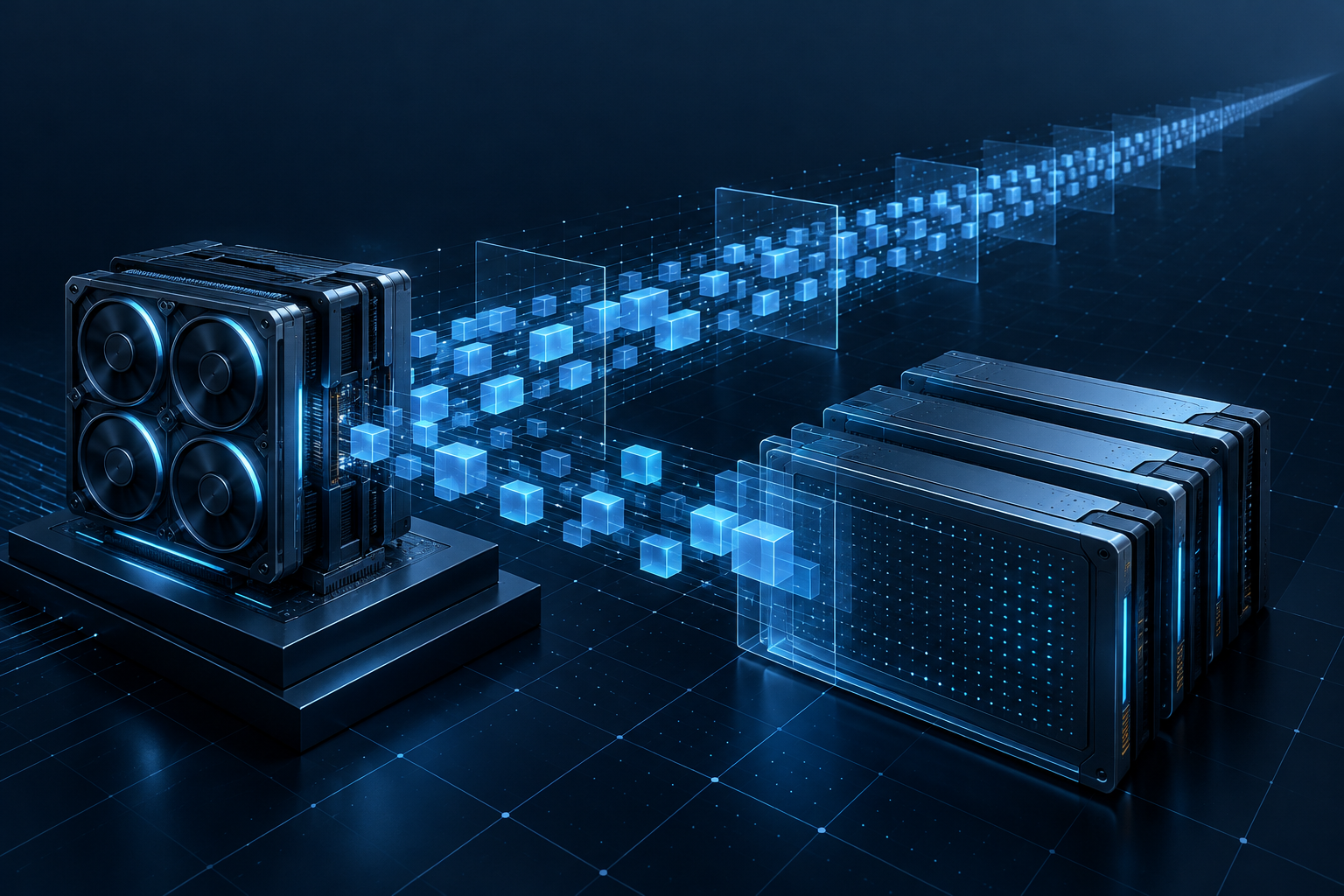
Long-context inference has a persistence problem as well as a memory problem. Once a model has processed a document, conversation, or continuing stream, the resulting key-value state represents work already performed. If that context is needed again, repeating prompt processing means paying for the same computation again. Keeping all of the state in GPU memory avoids that repetition, but makes memory capacity part of the constraint.
The paper “Real Long-Term Memory for AI: A 50-Million-Token Window That Is Faster and Cheaper Than Recompute,” submitted on October 9, 2026, describes another approach. Its public memory layer, galahad-kv, stores transformer KV state on encrypted local NVMe storage and reloads it when needed. The reported results include block loading that is 2.8× to 4.3× faster than recomputation, 8.8× to 12.3× lower GPU energy use, and flat GPU-memory consumption across a 50-million-token stream.[5]
Those measurements make persistent state worth examining, but they need careful interpretation. They compare loading with recomputation under tested conditions, not complete serving systems across every workload. The architectural question is more useful than the headline alone: when should inference infrastructure retain previously computed model state as persistent data rather than regenerate it?
1. Treating KV State as Persistent Data
During prompt processing, a transformer generates key and value tensors. Autoregressive decoding reuses these tensors instead of recomputing the corresponding state for every previously seen token. The KV cache is therefore not just a collection of input text. It is model state produced by processing that text.
The described galahad-kv system saves this state in blocks associated with approximately 16,000 tokens. It writes the blocks to encrypted local NVMe storage and later reloads them byte-exact, according to the paper summary. The central mechanism is preservation and retrieval, not a smaller numerical representation or an approximation of the original state.[5]
That distinction changes the relationship between context and GPU residency. Previously processed context can remain available as stored state without requiring the complete stream's KV cache to remain in GPU memory. When a stored block is needed, the system can restore it instead of running the corresponding text through prompt processing again.
This approach should not be confused with simply increasing a model's nominal context limit. A larger limit permits more input, but does not by itself remove the cost of processing that input or retaining the resulting state. Persistent KV storage addresses how work is retained and reused across requests and time.
Nor should “long-term memory” be read as a claim about human-like recall. The concrete contribution described here is a storage mechanism for transformer state. The reported 50-million-token stream demonstrates the scope of that mechanism under the tested conditions, not a general guarantee that every application can use arbitrary amounts of context with unchanged performance or quality.[5]
2. Reading the Performance Claims Correctly
The first reported result is that loading a stored block was 2.8× to 4.3× faster than recomputing its KV state. The relevant baseline is processing the corresponding text again. This is a direct comparison between two ways of obtaining already computed state: restore it from storage or regenerate it through model execution.[5]
It is not a reported 2.8× to 4.3× improvement in total request latency. A request may involve work beyond restoring reusable context, and the available summary does not establish how much of an application's total execution time that restoration represents. It also does not establish an advantage over accessing state that is already resident in GPU memory.
The second result is 8.8× to 12.3× lower GPU energy use for loading a block than for recomputation. This supports the argument that repeated prefill can consume GPU resources unnecessarily when suitable reusable state exists. However, GPU energy is not the same measurement as total system energy or total operating cost. The reported range should not be converted directly into an infrastructure savings percentage.[5]
The available material also lacks the exact model architecture, GPU model, NVMe device, block-level latency, and workload configuration for every point in the reported ranges. Without those details, the numbers cannot support a direct purchasing comparison between storage devices, GPU configurations, or inference engines.
The useful conclusion is narrower and still consequential: under the paper's tested conditions, retrieving persistent KV state beat regenerating it on both loading time and GPU energy. Teams should treat those ranges as evidence for evaluating the mechanism, not as guaranteed multipliers for their own deployments.
3. What Flat GPU Memory Does and Does Not Establish
The paper reports flat GPU-memory consumption over the full 50-million-token stream. This is a significant property because it separates the amount of context processed over time from the amount of state that must remain resident on the GPU.[5]
Long-context inference has two distinct costs. Prefill creates the initial KV state by processing the input. Decoding then requires retaining and accessing relevant state while generating output. Persistent storage targets repeated prefill when context is reused, while external state storage changes where that state can live.
The described system stores approximately 16,000-token blocks externally and loads them as required. That arrangement supports the reported flat GPU-memory result. It does not mean the underlying KV state disappears, becomes free to store, or shrinks numerically. The contribution is a change in storage placement and reuse, rather than a reported reduction in the representation of each saved block.[5]
Flat GPU memory also does not establish flat latency, constant storage demand, or unchanged throughput as the stream grows. Those are separate properties that require separate measurements. Likewise, the stream length alone does not demonstrate a conventional 50-million-token, fully GPU-resident attention window.
For infrastructure planning, this distinction matters. A system can avoid GPU-memory growth while still depending on the behavior of its storage layer. The paper summary does not describe enough of the block-selection, indexing, or scheduling policy to determine how that behavior changes across workloads.
The supported interpretation is therefore operational: the system demonstrates a way to retain a very long effective context without keeping the entire stream's KV state resident in GPU memory. How that translates into application responsiveness remains an evaluation question.[5]
4. NVMe Becomes Part of the Serving Architecture
In this design, local NVMe storage is not merely a destination for checkpoints or archived inputs. It participates in inference by holding state that model execution may need to restore. Storage behavior therefore becomes part of the serving path.
The brief confirms encrypted local NVMe storage and approximately 16,000-token blocks. It does not report the indexing policy, eviction algorithm, encryption method, concurrent-request scheduler, or storage queueing strategy. These missing details limit what can be concluded about multi-tenant production operation.[5]
For engineers, the next questions follow directly from that boundary change:
- Block management: How are saved blocks identified, admitted, located, and evicted?
- Storage behavior: What bandwidth and latency does restoration require under the intended workload?
- Encryption: What overhead does the chosen encryption method introduce?
- Concurrency: How are competing requests scheduled when they need stored state?
- Compatibility: How is stored state kept consistent with the model and runtime version?
- Recovery: What happens when a saved block is unavailable or cannot be restored?
These are evaluation requirements, not documented capabilities of galahad-kv. The available source does not provide enough information to answer them.
Local storage also makes deployment topology a relevant question. The reported design uses local NVMe, while the summary provides no distributed-serving or cross-request scheduling results. Buyers should therefore avoid assuming that a single-GPU restoration result carries unchanged into a distributed cluster.[5]
The architectural opportunity remains clear: storage can substitute retrieval for repeated GPU computation. But assessing that substitution requires more than measuring an isolated read. Teams need to understand the complete state lifecycle and the interaction between storage access and the requests their service must handle.
5. Reuse Determines Where the Approach Is Useful
Persistent KV storage is most relevant when previously processed context will be used again. Continuing streams, large documents, persistent agents, and session histories are plausible candidates because they can involve repeated access to long, stable context. The benefit depends on actual reuse, not simply on a prompt being long.
A stored block is useful when restoring it is faster or less expensive than regenerating it. If context is rarely reused, or storage retrieval is slow relative to recomputation, persistence may not provide the same advantage. The source summary does not quantify the reuse rate or identify a break-even point.[5]
This suggests a workload-first evaluation rather than a headline-first purchase. Teams should establish how often their applications revisit already processed context and how much repeated prefill that creates. They should then compare restoration with recomputation using their own models, hardware, and representative inputs.
The comparison should keep different baselines separate. Restoring state from NVMe is not the same operation as using a GPU-resident cache. Recomputing a block is not the same baseline as recovering it from host memory. The brief does not provide the detail needed to rank persistent NVMe storage against those alternatives across workloads.
An evaluation should also distinguish block-level results from service-level outcomes. Measuring restoration latency and GPU energy tests the paper's central mechanism. Measuring request latency, throughput, and behavior under concurrent load tests whether that mechanism helps the intended service.
Neither result should substitute for the other. A favorable block-restoration benchmark can justify further integration work, but the operational decision depends on whether repeated-context reuse is important enough to improve the application's overall serving behavior.
6. Byte-Exact Restoration and the Limits of Reproducibility
Persistent storage differs from KV-cache optimization methods that reduce or approximate state. Quantization represents keys and values with fewer bits. Pruning or retrieval approaches retain selected state. As described in the brief, galahad-kv preserves saved KV state and moves it outside GPU memory, with byte-exact restoration.[5]
That property is important for interpreting accuracy expectations. The mechanism does not report a lossy compression step during restoration. Its stated gains come from avoiding recomputation and extending the storage hierarchy, not from reducing the numerical representation of the stored tensors.
However, byte-exact restoration is not a substitute for task-level quality evaluation. The available summary does not provide task-level accuracy measurements. It therefore supports a claim about the fidelity of restored state, but not a quantitative claim about model-quality preservation across applications.[5]
The paper also states that its test protocol is designed to resist common ways of gaming long-context benchmarks. It includes a single-GPU reproduction using public software and a free license for the package. These provisions make the reported approach more accessible for examination.[5]
Accessibility is not the same as production validation. The retrieved material does not provide results for multiple simultaneous users, distributed GPU serving, NVMe contention, failure recovery, or cross-request scheduling. Nor does the summary contain all hardware and software details needed for a full independent comparison.
Teams should consequently separate three questions: can the mechanism be reproduced, does restoration outperform recomputation on their workload, and does the integrated service meet production requirements? The paper's reported single-GPU reproduction addresses the first question under its test conditions. The second and third still require workload-specific evidence.
7. What This Means for Teams Running Their Own Inference Infrastructure
For teams operating their own inference stack, the most useful lesson is to treat repeated prefill as an explicit optimization target. When a service repeatedly processes the same long context, increasing GPU capacity is not the only architectural option. Retaining and retrieving previously computed state is another approach worth testing.
Start by identifying where context actually repeats. Distinguish reusable history or stable document content from input that is processed once. Then establish a recomputation baseline for the reusable portion. That provides a concrete reference for testing persistent-state restoration rather than relying on the published speedup range.
A staged assessment can keep the decision grounded:
- Test restoration against recomputation. Measure block-loading time and GPU energy on representative context.
- Check memory behavior. Confirm GPU-memory use across the intended stream or session length.
- Evaluate storage requirements. Examine latency, bandwidth, encryption overhead, and state-management behavior.
- Test the serving workload. Include concurrent requests and storage contention rather than stopping at isolated block retrieval.
- Validate operational behavior. Establish compatibility, recovery, and application-quality expectations before deployment.
The source does not establish results for all of these steps. They are the work needed to translate a promising mechanism into an infrastructure decision.
The reported combination of faster restoration, lower GPU energy, and flat GPU memory makes persistent KV state a meaningful direction for long-context serving. It does not establish that NVMe storage should replace every other cache tier, or that a 50-million-token stream guarantees production-scale throughput.[5]
The central shift is straightforward: model state can be something the service retains, not merely something it recomputes or keeps permanently on the GPU. For teams with substantial repeated-context workloads, that changes the question from how much context fits in GPU memory to which state should be retained, where it should live, and when retrieving it is better than computing it again.
Sources
- [1]Reproducible LLM Inference Benchmarking: A Sequential Isolation Protocol for Regression Testing
- [2]vLLM vs SGLang vs TensorRT-LLM vs Dynamo - Agentic AI Wiki
- [3]Secure Speculative Decoding for Large Language Models
- [4]SGLang vs vLLM vs TensorRT-LLM: Choosing an Inference Engine
- [5]Paper page - Real Long-Term Memory for AI: A 50-Million-Token Window That Is Faster and Cheaper Than Recompute
- [6]Language Models Discover Faster Molecular Relaxation
- [7]開発者ワークフローにおける自律型LLMの体系的比較 - AIDB
- [8]Efficient Long-Context Inference research | The Latest in AI
- [9]LLM Daily: October 08, 2026
- [10]Daily-HuggingFace-AI-Papers/data/daily/2026-10-06.json at main · AtharvaDomale/Daily-HuggingFace-AI-Papers
- [11]RL Training Methods | verl-project/verl | DeepWiki
- [12]SEIS: Autonomous Inference Systems for Efficient Language Model Deployment
- [13]Cache the Encoder Within:Compact, Reusable Memory across LLM Queries
- [14]Rohan Paul (@rohanpaulai) on X
- [15]Multi-Node LLM Inference on Serverless Clusters
Researched from the sources above and fact-checked against them before publishing.
See what this means for your infrastructure.
Book a discovery call and get a benchmark projection for your hardware and model.
SCHEDULE A CALL