
LLM Enhancements
RigTune and the Case for GPU-Specific LLM Serving Benchmarks
RigTune automates GPU-specific serving comparisons. Its promise is less manual tuning, not a proven universal performance gain.
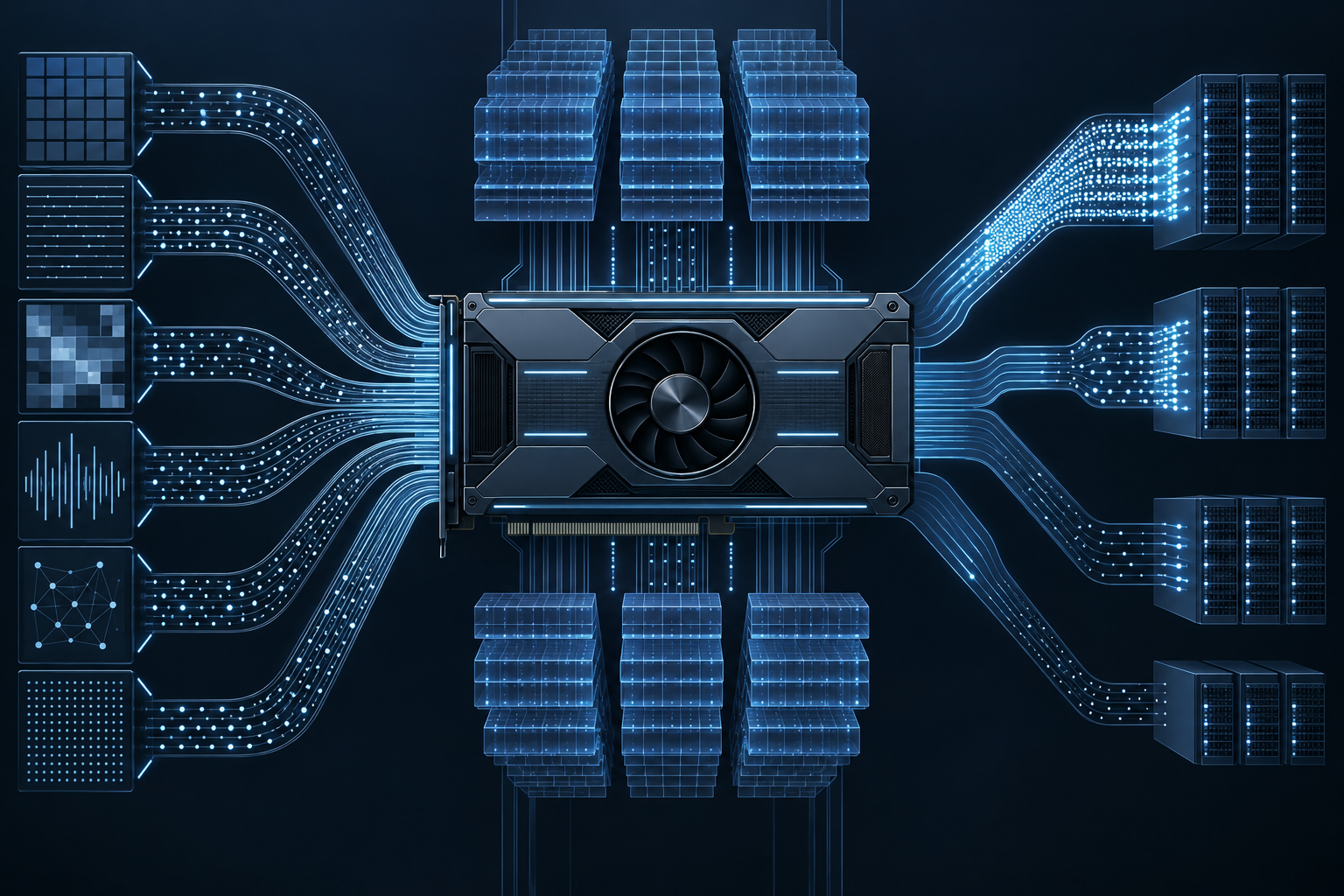
Choosing an LLM-serving engine is not the same as choosing the fastest way to run a model. Performance depends on the interaction between the model, GPU, serving implementation, memory capacity, batching behavior, precision, and incoming workload. A configuration that works well for one deployment may be a poor match for another. That makes configuration selection an empirical systems problem, not simply a comparison of engine feature lists.[8]
RigTune targets that selection problem. Reported as an open-source project released on November 19, 2026, it benchmarks serving engines including vLLM, Text Generation Inference (TGI), and SGLang to identify the fastest configuration for a selected GPU. Its contribution is automated, hardware-specific comparison, not a new decoding algorithm.[7]
For teams operating inference infrastructure, the idea is practical: measure candidate stacks on the hardware that will run them rather than assume a default is optimal. But the evidence supports a limited conclusion. The available reporting describes the tool and its purpose without supplying numerical speedups, a detailed benchmark methodology, or proof that automated selection outperforms careful manual tuning. Understanding both the opportunity and those limits is essential.
1. What RigTune Automates, and What It Does Not Establish
RigTune's reported workflow is comparative benchmarking across serving engines and configurations on a target GPU. Instead of treating vLLM, TGI, or SGLang as a universally superior choice, it uses measurements to identify which arrangement serves a model fastest on the selected hardware.[7]
That is a tooling contribution with a clear operational target. Manually comparing engines requires teams to test alternatives and interpret their results. Automating those comparisons may reduce configuration-search effort and help teams discover a faster arrangement than a fixed default. The available evidence does not quantify that reduction in effort or the resulting performance benefit.[7]
The scope also needs careful interpretation. The reporting establishes support for comparing the named engines, but it does not provide the exact configuration parameters RigTune searches. It would therefore be premature to describe it as automatically optimizing every precision format, scheduling policy, cache setting, or decoding technique available in those engines. Those mechanisms belong to the broader serving optimization space; their presence in that space does not establish that RigTune controls them.[7][8]
The distinction is important for infrastructure buyers. A configuration-selection tool and an inference engine solve different problems. RigTune is described as measuring serving implementations and identifying a preferred configuration. It is not reported as replacing their execution machinery, improving model quality, increasing maximum context length, or introducing new inference algorithms.[7]
The defensible claim is consequently narrow but useful: RigTune automates hardware-specific serving comparisons. Whether its selected configuration is suitable for a particular production service still depends on the objective, workload, and constraints represented in the evaluation.
2. “Fastest” Requires an Explicit Service Objective
LLM-serving performance is not a single number. Latency, throughput, memory efficiency, operating cost, and service reliability are distinct optimization targets. Improving one does not automatically improve the others, and the preferred balance depends on the deployment objective.[8]
An interactive application may prioritize how quickly a response begins and how responsive generation feels. A high-volume processing workload may place greater weight on aggregate throughput. A configuration that delivers strong throughput under concurrent load is not necessarily the configuration that minimizes latency for an individual request. High-batch-throughput settings can also affect time to first token and responsiveness.[8]
This means that “fastest on this GPU” needs qualification. Fastest for which model, prompt lengths, output lengths, and concurrency level? Fastest according to which measurement? Without those boundaries, a benchmark winner can appear more general than the evidence supports.
Teams evaluating RigTune should therefore define their selection rule before interpreting a result. A useful evaluation plan would specify:
- The latency and throughput measures that matter to the service.
- The prompt and generated-output lengths represented in testing.
- The concurrency conditions under which configurations are compared.
- The memory, reliability, and cost constraints a candidate must satisfy.
These are evaluation recommendations, not documented RigTune features. The available reporting does not explain which performance metric governs its ranking or how it handles competing objectives.[7]
For engineers, an explicit objective makes the comparison actionable. For buyers, it prevents an attractive performance headline from substituting for a deployment requirement. A configuration should be judged against the service it must support, not against an undefined notion of speed.
3. Why GPU and Workload Shape Change the Answer
The case for hardware-specific selection begins with the different behavior of prefill and decode. Prefill processes the input prompt and is generally compute-intensive. Decode generates tokens sequentially and is commonly constrained by memory movement and cache access. These phases place different demands on the serving stack.[8]
Workload shape changes their relative importance. Prompt length, generated-output length, concurrency, and GPU memory bandwidth can all affect how optimization techniques behave. Consequently, two deployments using the same model can present different performance problems even before the serving engine changes.[8]
This is why benchmarking a model in isolation is insufficient to establish a universal engine ranking. A short interactive prompt and a long-context request do not exercise the stack in the same way. Similarly, a lightly loaded service and a high-concurrency service can expose different trade-offs in scheduling, batching, and memory use.[8]
Hardware-aware evaluation narrows the question to something measurable: which candidate configuration performs best for the selected objective on this GPU under this workload? That is a more useful question than which engine is fastest in general, and it matches RigTune's reported emphasis on the user's hardware.[7]
However, using the target GPU addresses only one dimension of representativeness. Teams should also make their test traffic resemble the deployment they intend to operate. A result from one prompt-length distribution should not be assumed to apply to another without evaluation.
The practical implication is to treat every winning configuration as conditional. Record the model, hardware, workload, and objective alongside the result. That keeps a local measurement from becoming an unsupported platform-wide rule and makes the reason for choosing a configuration easier to review later.
4. Optimization Techniques Interact Rather Than Add Up
The serving optimization space includes quantization, speculative decoding, prefix caching, chunked prefill, continuous batching, and optimized GPU kernels. These mechanisms address different bottlenecks, which helps explain why engine and configuration selection cannot be reduced to counting supported features.[8]
Quantization reduces the size of model data and can mitigate memory-bandwidth pressure during generation. The technical context in the brief states that halving precision reduces memory payload size by 50%. That is a statement about data volume, not a guarantee of 50% lower latency or a corresponding improvement in end-to-end throughput. The actual serving result still depends on the implementation and the other work involved.[8]
Speculative decoding addresses generation differently. A lightweight draft mechanism proposes candidate tokens, and the target model verifies them. Under suitable conditions, accepting multiple tokens can advance generation with fewer expensive target-model decoding steps. RigTune is not reported as introducing a new version of this technique; its role is comparative serving evaluation.[8][7]
Caching and scheduling introduce further interactions. Prefix caching can avoid recomputing shared prompt prefixes. Continuous batching changes how requests are scheduled and grouped. Chunked prefill can balance prompt processing against active decoding work. Optimized GPU kernels can change relative performance across sequence lengths and batch sizes.[8]
These mechanisms are reasons to measure the complete serving arrangement rather than extrapolate from one optimization in isolation. A reduction in one kind of work does not establish the end-to-end result for every workload.
Teams should nevertheless distinguish the broader search space from RigTune's documented capabilities. The available evidence does not enumerate which of these mechanisms it tests or which combinations it can select. That capability should be established before planning an evaluation around it.[7]
5. What the Available Evidence Supports
The strongest concrete claims are straightforward: RigTune is reported as open source, released on November 19, 2026, and designed to benchmark engines including vLLM, TGI, and SGLang to find the fastest configuration for a selected GPU. Those claims establish the project's reported purpose and scope.[7]
They do not establish a measured advantage over existing operational practice. The available reporting does not provide a tested model list, GPU list, detailed benchmark methodology, exact configuration parameters, or statistical confidence intervals. It also does not report numerical speedups over a manually chosen configuration.[7]
Several conclusions would therefore go beyond the evidence. There is no supplied result showing better tokens per second, time to first token, inter-token latency, GPU utilization, cost per token, or throughput per watt. Nor is there evidence here that RigTune reduces memory consumption or improves model quality. Those are separate outcomes that would require their own measurements.
The broader serving material explains why configuration choices matter, but it is not a RigTune benchmark. Context about latency-throughput trade-offs, memory behavior, and optimization mechanisms supports the motivation for the tool. It does not independently validate the tool's effectiveness.[8]
For technical evaluation, this distinction separates three questions: does the project perform the described comparisons, are those comparisons representative of the intended service, and does the selected configuration improve on the team's baseline? The available evidence describes the first as the tool's function but does not settle the latter two.
Open-source availability makes RigTune a candidate for evaluation, not a substitute for evaluation. The appropriate posture is to test the reported workflow and inspect its assumptions before using its rankings to justify production changes or infrastructure purchases.
6. How to Evaluate Automated Configuration Selection
A useful RigTune trial should begin with a baseline and a deployment objective. The baseline could be the team's current serving configuration or another explicitly chosen reference. The objective should identify the performance improvement being sought and the constraints that cannot be traded away.
Next, define the workload. Use prompt lengths, generated-output lengths, and concurrency conditions that reflect the intended service. Because those factors influence serving behavior, a comparison that omits them may answer a different question from the one the team needs resolved.[8]
Before running the comparison, inspect the tool's scope. Determine which engines, configurations, and measurements the available implementation actually supports. The reporting does not supply those details comprehensively, so an evaluation should not assume them. In particular, establish what “fastest” means in the ranking and whether that matches the service objective.[7]
The resulting evidence should separate observations from expectations. Record the configuration, test conditions, and measured outcomes rather than describing a candidate as broadly superior. If a configuration improves throughput, examine the associated latency behavior before selecting it for an interactive service. If it improves latency, check whether it still meets the required concurrent-load objective.
Finally, distinguish discovery from deployment approval. An automated search can identify a promising candidate, while the production decision should also account for the reliability, memory, and operating-cost targets relevant to the service. Those targets are part of inference optimization, even when a tool emphasizes speed.[8]
This process does not assume that RigTune already implements every step. It provides a framework for deciding whether its output is useful. The meaningful outcome is a configuration supported by deployment-relevant measurements, not merely a first-place position in a benchmark table.
7. What This Means for Teams Running Their Own Inference Infrastructure
RigTune points toward a practical approach to self-managed inference: treat serving-stack selection as a measurement problem tied to actual hardware and traffic. The value of that approach is not a universal engine ranking. It is a more defensible way to choose among implementations whose behavior depends on the deployment.[7][8]
For engineers, the immediate opportunity is to evaluate whether automated comparisons can reduce manual search effort while preserving control over test conditions. For infrastructure buyers, the priority is to connect any claimed improvement to the service objective and baseline that produced it. A faster benchmark configuration is relevant only if its advantages carry into the intended operating conditions.
The evidence does not yet justify a numerical return-on-investment claim, a capacity forecast, or a claim that RigTune outperforms expert manual tuning. Its reported promise is operational: automate comparative measurements and help identify a faster engine-and-configuration combination for a chosen GPU.[7]
Teams should therefore approach it as a candidate addition to their evaluation workflow. Define success, inspect the supported search space, compare against a known baseline, and retain the conditions behind every result. That discipline matters more than the identity of the winning engine.
The broader lesson is simple: defaults are starting points, not proof of optimality. RigTune addresses the work required to test those defaults. Whether it delivers a meaningful advantage for a particular inference platform remains a question for representative, objective-driven measurement.
Sources
- [1]GreenDynaMix: Thermal-Aware Dynamic Mixed-Precision MoE LLM Inference Systems
- [2]Draft Calibration for Speculative Decoding: Accelerating LLM Serving by Matching Draft and Target Distributions
- [3]The second KV cache: why speculative decoding's memory bill is not the one you modeled
- [4]TL;DR: Speculative Decoding Is Less Speculative Than You Think | ArXiv TLDR
- [5]Optimized multi-token drafting cuts speculative decoding overhead
- [6]SpecSearch: Towards Hardware-Aware Efficient Speculative Decoding
- [7]RigTune: Tool Finds Fastest Way to Serve LLMs on Your GPU
- [8]Inference Engineering in Production: LLM Serving, Optimization, and Scale
- [9]Towards Energy-Efficient Large Language Model Inference: A Systematic Literature Review
- [10]AI Model Serving Performance Engineering Explained
Researched from the sources above and fact-checked against them before publishing.
See what this means for your infrastructure.
Book a discovery call and get a benchmark projection for your hardware and model.
SCHEDULE A CALL